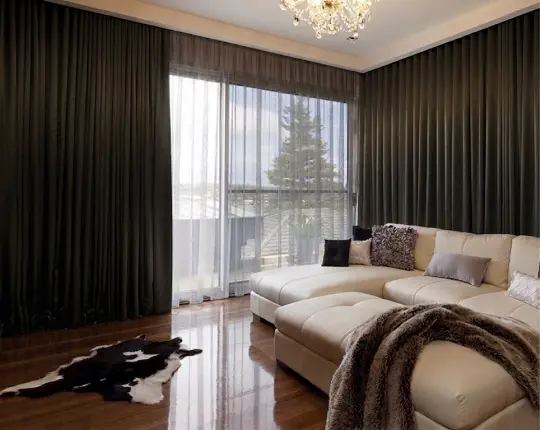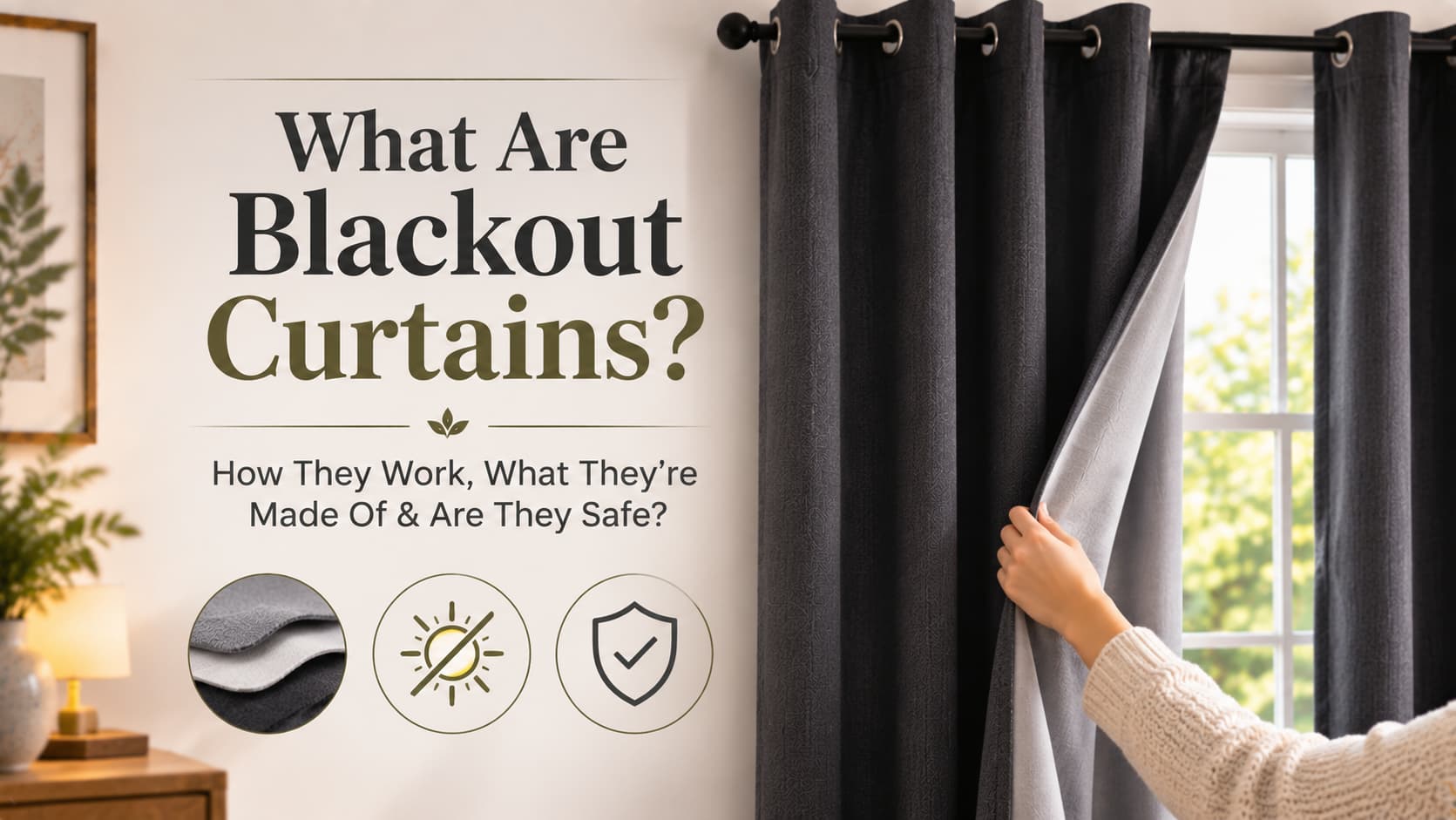
What Are Blackout Curtains? How They Work, What They’re Made Of & Are They Safe?
Blackout curtains are thick curtains that block sunlight from entering a room. The sunlight these curtains block reaches your bedroom every morning to disturb you. You are asleep when sunrise brings the day’s 1st sunlight into your bedroom, and wakes you up before your alarm does.
With that said, if waking up too early and keeping your room cool are concerns for you, this guide is for you.
What Are Blackout Curtains?
Blackout curtains are special types of curtains that block sunlight and heat entering indoors.
What Do Blackout Curtains Do?
Blackout curtains have a dense layer behind the decorative fabric. That layer stops sunlight and street light from passing through. A blackout curtain pair that is wider and taller than the window frame can block about 99.9% of daylight. Light then has no gap to enter through.
How do Blackout Curtains Work?
An ordinary curtain fabric has tiny spaces between its threads, which let sunlight into your room. A blackout curtain has no tiny spaces between its threads as its threads are tightly held together or sometimes there is a coating behind its threads, leaving no space for light to enter.
Do Blackout Curtains Really Work?
Yes. Blackout curtains made with the right material effectively block light and heat entering your room, helping you obtain absolute darkness and cooler temperature. We’ll cover the right blackout curtain material later in the blog post.
How Long Do Blackout Curtains Last?
High-quality blackout curtains can last between 5 to 15 years and even more, provided that they are being maintained well by the user. Daily sun exposure causes low quality blackout curtains fabric to fade and become brittle over time and that’s why purchasing a high-quality blackout curtain is essential.
At Aura Curtains, we offer the premium range of blackout curtains that lasts over 15+ years.
3 Main Types of Blackout Curtains
The word blackout has no legal definition but there are 3 different ways manufacturers craft a blackout curtain. You can find its type printed on the label of the blackout curtain you purchase. The 3 types of blackout curtains are:
- Separate lining blackout curtains: If the seller offers you this type, the maker sewed a tightly woven polyester or cotton layer behind the decorative front fabric. That layer is the lining, an extra piece of fabric sewn separately behind the front. Light that passes through the front fabric meets the lining and stops there.
- Coated back blackout curtains: If the seller offers you this type, the maker applies a foam or rubber coating to the back of the fabric. The coating seals the weave, which means it fills the spaces between the threads. This variant of blackout curtain blocks light well but raises a safety question that a later section of this guide covers.
- Triple weave blackout curtains: If the seller offers you this type, the maker wove three layers into one fabric and placed a dark layer in the middle. The dark layer absorbs light, which means it takes in the light that reaches it. The curtain hangs as a single piece, so it has no separate lining.
Blackout Vs Room Darkening Curtains: What’s The Difference?
Some brands sell room-darkening curtains that do a good job of blocking incoming light from outside. However, they still allow a soft ambient glow to enter around the edges. What makes blackout curtains the best choice for completely blocking light is their specially designed construction and fabric material, which can block 99% to 100% of sunlight.
Can You See Through Blackout Curtains?
If you have purchased high-quality blackout curtains and installed them properly, it should not be possible to see through them. Blackout curtains are made of dense fabrics with multiple layers that make it nearly impossible for light to pass through or for people to see through the curtains.
Do Blackout Curtains Have To Be Black?
There is a common misconception that blackout curtains have to be black. However, they come in a wide variety of colors, as you can see at Aura Curtains. The term “blackout” is used because these curtains feature a blackout lining sewn into the back of the fabric, regardless of the color of the fabric on the front.
However, there is one important caveat: lighter-colored blackout curtains tend to show dust more easily over time, whereas this is less noticeable with black curtains.
What Is The Best Fabric For Blackout Curtains?
Of the 3 types of blackout curtains we listed above, the separate lining blackout curtain blocks the light completely and is safer than coated back blackout curtain. However, it works only when the lining is thick and opaque, which means the lining lets no light pass through it.
How to Stop the Light Leaks Completely with Blackout Curtains?
A curtain needs two things to block light: 1) the right fabric and 2) a hang with no gaps.
The light leaks in at 3 gaps or points: 1) over the top of the curtain, 2) past the sides, and 3) under the bottom.
How to Hang Blackout Curtains in a Way So No Light Leaks Through?
To stop the light leaks completely with blackout curtains, you need to close all 3 places/gaps where light breaks into.
- Top: Fix the curtain rail (the bar the curtain hangs from) on the ceiling, or as high above the window as you can. A rail fixed right above the glass leaves a strip of open glass above the curtain, and sunlight comes in through that strip. A rail on the ceiling lets the curtain hang from the ceiling down, so no open glass is left above it.
- Sides: Make the curtain rail 10 to 15 cm longer on both sides of the window frame. A longer rail holds a wider curtain, so the fabric covers the wall next to the window. Light then has no way in at the edges of the window.
- Bottom: Let the curtain hang down to 1 cm above the floor. A curtain that ends at the bottom of the window leaves an open gap below it, and light comes in through that gap.
It is important to note that the gaps may be closed, but light can still come through the curtain if the fabric of your blackout curtain is too thin. So the next section names the materials of fabrics of blackout curtains that will stop light.
What are Blackout Curtains Made up of?
A blackout curtain is made of up to 4 layers, and most curtains combine several of the 4 layers below. Ask your supplier, the company selling you the curtain, which of these layers your curtain contains. Find that layer in the list below and read what it does:
-
Face fabric
Face fabric is the layer you see from inside your room. The maker can use cotton, linen, velvet, suede or polyester for it. The face fabric decides how the curtain looks.
-
Blackout lining
Blackout lining is the layer sewn behind the face fabric. It is the layer that stops light. The maker weaves it tightly from polyester or cotton, so light finds no spaces to pass through. It is usually done for linen curtains with no lining because those let light through, due to the small spaces between linen threads. The curtain maker sews a polyester blackout lining behind the linen, so the light that passes through the linen meets a layer that blocks it.
-
Coating layer
A coating layer is usually a foam or rubber layer that the maker applies behind the face fabric on some curtains. It seals the spaces between the threads.
-
Thermal layer
A thermal layer is an acrylic or polyester layer that some curtains add to slow heat from passing through the curtain into your room.
Note: All blackout curtain fabrics are dense and weigh more than an ordinary curtain. You can’t hang them on a weak rod as it will bend under curtain weight. You can contact Aura Curtains and let our team fit both the right rod and track for your next blackout curtain installation.
Why Dubai Homes Need Blackout Curtains
There are mainly 4 reasons Dubai homeowners need blackout curtains. Blackout curtains help them 1) sleep better, 2) lower their electricity bills, and 3) protect their furniture and flooring from sun fading, and ensure their babies are safe from harmful UV rays.
-
Do Blackout Curtains Help You Sleep?
A bedroom that faces east receives that light directly, and the light wakes you before your alarm. Besides that, many apartments in JBR, Downtown, and Business Bay have floor-to-ceiling glass in the bedroom. The glass passes the sunrise light straight to your bed, and at night, the same glass passes light from other towers.
An ordinary curtain lets light into your rooms, as the section on how blackout curtains work showed. But a blackout curtain closes the spaces between the threads, so your room stays dark while you are asleep.
-
Do Blackout Curtains Help You Get Relief in Electricity Bills?
Heat is the second problem. On top of that, the Dubai Electricity and Water Authority (DEWA) advises residents to keep windows covered to reduce the heat entering through glass. It recommends a 24°C thermostat setting, and it says each degree you lower the thermostat raises AC consumption by about 5%.
A blackout curtain slows heat passing through the window because its fabric is dense. Less heat reaches your room, so the air conditioner has less to cool and runs less. An air conditioner that runs less uses less electricity, so your electricity bill drops.
-
Do Blackout Curtains Help You Protect Furniture from Fading?
Sunlight that keeps shining on furniture or flooring slowly drains its colour. This loss of colour is called sun fading. A closed blackout curtain stops sunlight at the window. The sunlight then cannot reach your furniture or flooring, so their colour stays as it is.
-
Do Babies Need Blackout Curtains?
Science suggests that babies around 3 to 4 months of age may benefit from a dark sleeping environment to support their natural growth and development. Darkness helps regulate the production of melatonin, the hormone that promotes sleep. This is why blackout curtains can be beneficial for babies: they block sunlight and help reduce heat that may disturb an infant’s sleep throughout the day, whether in the morning or early afternoon.
This also raises two important questions:
I) Do You Need Blackout Curtains For A Nursery?
Many homes in the UAE have nurseries, dedicated spaces for babies, or special bedrooms for infants. Nurseries can be found in both homes and hospitals. Blackout curtains are good for nurseries because the pitch darkness they provide triggers the natural release of melatonin, which is important for growing infants who are around 4 to 5 months of age.
Blackout curtains also help block sunlight and harmful UV rays, creating a more comfortable environment for them throughout the day, which is important for a baby’s growth and development
II) When To Start And Stop Using Blackout Curtains For Baby?
Blackout curtains can be used in nurseries and babies’ bedrooms from around 3 to 4 months of age and can remain in use until children are about 3 to 5 years old.
You may consider stopping using blackout curtains when your child has completely stopped taking daytime naps or begins expressing a fear of total darkness, which is typical for children who are about 3 to 5 years old.
Are blackout curtains harmful to babies under 3 to 4 months old?
Yes. Experts advise parents to avoid using blackout curtains for babies who are under 8 weeks old (around 3 to 4 months of age). Babies at this age are still developing their circadian rhythm, which is the body’s internal clock that helps regulate when we feel awake and when we feel sleepy. For that reason, babies need to learn the difference between day and night. Keeping their room completely dark during the day may affect the light cues they experience.
Before installing blackout curtains in your baby’s room, consult a paediatrician, especially if your baby is under eight weeks old.
3 Proven Medical Benefits of Blackout Curtains
Below, we discuss the 3 main benefits of installing blackout curtains along with a case study.
1. A dark bedroom can lower your risk of 9 medical conditions.
Sleep affects your cardiovascular system (your heart and blood vessels), your digestive system and your nervous system. Doctors link too little sleep to the nine conditions in this list. Find a condition below to see what it means:
- Anxiety: constant worry that is hard to control.
- Coronary heart disease: narrowed arteries that supply blood to the heart.
- Depression: a long period of low mood.
- Hypertension: high blood pressure.
- Metabolic disorders: conditions that disrupt how the body uses energy.
- Obesity: a high level of body fat.
- Stroke: a blocked or burst blood vessel in the brain.
- Type 2 diabetes: blood sugar that stays too high.
- Work-related accidents: injuries that happen at work.
2. Blackout curtains help you sleep easily.
Your body runs on a 24-hour clock called the circadian rhythm, and light sets that clock. When your room is dark, your brain releases melatonin, the hormone that prepares you for sleep. Light that reaches your eyelids during the night weakens that melatonin signal, so your body gets a weaker cue to sleep.
3. Steady Sleep Schedules Lowered the Risk of Early Death.
Consistent sleep has two parts. The first is a dark bedroom, which a blackout curtain gives you. The second is a steady schedule, which means you go to sleep and wake up at similar times each day.
A study that used UK Biobank, a large health research project in the United Kingdom, tested whether a steady schedule matters. The researchers followed more than 60,000 people for almost eight years and compared how regular each person’s sleep times were.
People with the steadiest sleep schedules had a 20 to 48% lower risk of death over those years than people with the most irregular schedules. If you keep similar sleep and wake times, your risk of death over a period like this is lower than if your times change from night to night.
A Case Study: What one night did to healthy adults’ bodies
In 2022, researchers at Northwestern University, a university in the United States, studied what light in the bedroom does to the body. They asked healthy adults to sleep one night in a room with moderately bright light and one night in a room with darkness.
The next morning after they slept in a moderately bright light room, they saw their bodies respond worse to insulin, the hormone that moves sugar from the blood into cells. This worse response is called insulin resistance. When insulin resistance rises, the body has more trouble clearing sugar from the blood.
But when they slept in a dark room, they saw the next morning their heart rates stayed lighter during the night than they would have in a moderately bright room. These changes appeared after a single night of light, and all of the adults were healthy.
The research concluded that a bright bedroom can therefore affect your heart and your blood sugar after one night, even when you have no health condition.
Blackout Curtains Vs Blinds: Which Is Better?
Match your situation to a line in this list:
- If the room is a bedroom: choose blackout curtains. Blackout curtains hang wider than the window frame, so the fabric covers the wall on both sides of the window and light cannot come in at the edges.
- If the window is small, or sits in a kitchen or home office: order a custom blackout roller blind. A roller blind easily fits inside a small window frame, and you roll it up to clear the window.
- If you want full darkness at night and soft light by day: choose our blackout curtains duo layered with sheer curtains. It has a blackout curtain in front of sheer curtains. Close both layers at night. Close only the sheer curtain by day.
- If you want the darkest room you can build: hang blackout curtains in front of a blackout blind. Light has to pass through two layers that each block light before it reaches you.
Are Blackout Curtains Bad For You? What Are The Disadvantages Of Blackout Curtains?
Below we discuss the 3 problems that come along with blackout curtains along with a fix for each.
New Blackout Curtains Can Smell Bad
New synthetic fabrics and foam or rubber backings can release VOCs (volatile organic compounds, chemicals that evaporate into the air) for a short time after you unpack them. This release is called off-gassing, and it is the cause of the chemical smell.
Are Blackout Curtains Toxic?
No. Blackout curtains are not toxic, however, to set safe exposure levels, you need to take the three steps below in this order:
- Before you order: Ask the seller for the test certificate of the exact fabric you are buying. You can ask us the same question.
- On installation day: Open a window or balcony door for several hours. Fresh air then replaces the air around the new fabric.
- If a smell stays after a few days: Tell the seller.
Two certificates show that a fabric was tested. Look for them on the test certificate:
- OEKO-TEX Standard 100: a laboratory tested the finished fabric for harmful substances. Class 1 is the strictest class and covers baby products.
- GREENGUARD: a laboratory tested the product for the chemicals it releases into indoor air.
Cotton and linen face fabrics (the layer you see from the room) release fewer chemicals than synthetic fabrics. These face fabrics still need a blackout lining to stop light, so ask the seller what that lining is made of.
Blackout Curtains Being Unsafe for Young Children
Cords on curtains and blinds can strangle young children. If a baby or toddler sleeps in the room, choose motorized curtains or cordless blinds. Tie any loose cord high up, out of a child’s reach.
Blackout Curtains Can Become the Reason People Wake Up Groggy
Sleep experts say morning light helps your body release cortisol, a hormone that makes you alert. A fully dark room gives your body no morning light, so your body gets no signal to release cortisol. Some people who add blackout curtains report feeling groggy (tired and slow) in the morning. Their bedtimes and wake-up times drift later.
To fix this, let light into your room at the hour you want to wake up. Find your situation below and follow the line beside it:
- If you wake to an alarm: open the curtains the moment it rings. Daylight reaches your eyes, and your body starts producing cortisol.
- If you don’t wake to an alarm: choose motorized curtains. Our motorized curtains and blinds work with a remote, a mobile app, Alexa, Google Home, and Apple Home. You set the curtain to open automatically at time you wake up, and the sunlight enters the room, and your body gets the morning signal without you leaving the bed.
How to Know if Blackout Curtains are the Right Choice for you
Again, find your situation in this list and follow the line beside it:
- If you work night shifts: you sleep while the sun is up, and Dubai gives you about 10 hours of sun a day. A blackout room creates an artificial night for your daytime sleep.
- If you have a baby or toddler: a dark room helps naps happen in bright afternoons. Ideal Home’s 15 October 2026 guide names infants, light sleepers, and shift workers as the people for whom a fully sealed, layered set-up makes the biggest difference.
- If you wake easily: the Penn State study found that bright rooms lowered sleep quality in young adults, and a blackout curtain removes that brightness at the window.
- If you fly often: you land at odd hours and sleep when your body clock says it is day. Blackout curtains give you a dark bedroom at any hour.
5 Places to Install Blackout Curtains
People use blackout curtains in five kinds of places. Find your space in this list to see what they do there:
- If you are fixing a bedroom: install blackout curtains there to keep the room dark at any hour, so you can sleep past sunrise.
- If you are fixing a living room: install blackout curtains on the window where afternoon sun glares on your television. The curtains cut the glare, so you can watch in daylight.
- If you are fixing a whole home, such as a villa, apartment or penthouse: install blackout curtains in the main rooms. The sun fades sofas and wooden floors over time, and the curtains block that sun.
- If you run a hotel: install blackout curtains in guest rooms. Guests who land on overnight flights can then sleep through the morning.
- If you design interiors for clients: sew a blackout lining behind the decorative fabric your client chose. The client keeps that fabric and gets a dark room.
Pair blackout curtains with sheer curtains and you get a dual layer system. The sheer layer softens daylight, and the blackout layer stops it. You close one layer, both layers, or neither, so you choose full darkness, gentle daylight, or an open view, whichever the hour calls for.
Both layers depend on one idea, so the next section explains how a blackout layer stops light. We learn about that in next section.
Setting Up a Dual Layer System (Blackout Curtains + Sheer Curtains)
A dual layer system hangs two curtains in front of one window. The sheer curtain hangs closest to the glass, and the blackout curtain hangs in front of the sheer. A double track or double rod holds both, and our team fits it during the visit.
The window then has three settings. Find the time of day you care about in this list:
- Morning and evening, when you want the view: open both layers.
- Afternoon, when the sun is strongest: close the sheer only. The sheer softens the glare, and daylight stays in the room.
- Bedtime, nap time, or movie night: close both layers. The blackout layer stops the light, and the room goes dark.
The same system suits several spaces. In a living room, the sheer handles the afternoon and the blackout handles movie night. In a hotel suite, guests choose their own light level without calling reception. In an interior design studio, you can show a client both settings on one window and let them choose.
A dual layer system works only when the curtains are cut and hung to stop light at the edges. That is where most blackout curtains fail, so the next section covers it.
Time for a final decision
If you’re looking to purchase blackout curtains, we have simplified the decision-making for you. Find your situation in this list to see suits you the most:
- If you want the darkest bedroom: shop blackout curtains with a ceiling track and wide overlap.
- If you want darkness at night and daylight by day: order blackout curtains duo that comes with a sheer layer. We offer a dual-layer system in which you get a blackout and sheer curtain combo.
- If you wake groggy or share a room with a baby: Get a quote for custom motorized blackout curtains, which open and close on a schedule automatically.
FAQs
What does it mean by blackout curtains?
Blackout curtains are specialized curtains made up of dense fabric that blocks outside light and heat easily. These curtains also reduce outside noise and glare as well.
What are blackout curtains used for?
Blackout curtains are mostly used for blocking outside light and heat as they do a good job blocking 99% of external light and UV rays. They are commonly used in bedrooms where people complain they wake up before their alarm due to early and direct sunlight. Blackout curtains block the light save them from trouble of waking up earlier than intended. Besides a bedroom, they’re also used in nurseries, Media rooms, kitchens, and home theatres.
When were blackout curtains invented?
Blackout curtains were first created during World War II in 1939.
Who created/invented blackout curtains?
It’s not listed in history books who was the person behind inventing these specialized curtains. However, during WW2 in 1939, the British government enforced Air Raid Precautions regulations where it was asked to the people of Britain to hang black dense fabrics over their windows, so that inside light could not escape outside. This suggests that the concept of blackout curtains may have originated in Britain.
Why did they have blackout curtains in WW2?
They used them to protect their homes, factories, and other buildings from enemy air raids. The thick, heavy blackout curtains they hung over their windows prevented light from escaping and being seen from outside, especially by enemy bomber planes.
Do blackout curtains block 100% of light?
Yes. A well-made pair hung with the right overlap covering the top, right, left, and bottom blocks about 99.9% of external light.
Are blackout curtains soundproof?
Blackout curtains soften the outside noise but don’t block them completely. A soundproof room needs wall-level work. Blackout curtains have dense fabric that absorbs some sound, making noise less disturbing.
Do blackout curtains mess with your circadian rhythm?
Yes. Blackout curtains when not used wisely can mess with your circadian rhythm, making it harder for you to wake up. While they help you sleep at night by blocking artificial light and prevent morning sunlight from waking you up before your alarm, keeping them closed throughout the day can prevent natural light from entering your room and reaching your eyes.
Without this light cue, your brain can continue producing melatonin, leading to morning grogginess, brain fog, and a delayed wake-up time.
How do blackout curtains help in the kitchen?
Kitchens can become even hotter when direct sunlight enters through the windows. Blackout curtains help block sunlight, reduce solar heat gain, and keep the kitchen cooler and more comfortable during the day.
How long does their installation take?
Blackout curtains and blinds both take about 30 minutes to install on each window. This way, the entire installation finishes within a few hours.
What do blackout curtains look like from outside?
Blackout curtains look like normal curtains from the outside and are usually white, cream, or other light colors. Curtain manufacturers usually prefer these colors to give buildings a clean exterior appearance from the street.
How to tell if curtains are blackout?
You can test your blackout curtains in two ways. First, when you purchase them, hold a bright flashlight against the fabric and see if any light passes through. Second, hang them over a window and check whether any sunlight leaks through.
Are there white blackout curtains?
Yes, you can find white blackout curtains that block up to 99% of outside light and glare, just like black blackout curtains. Their outer color doesn’t necessarily determine how much light they block, provided they are made of good and dense fabric material.
What are grey eyelet blackout curtains?
Grey eyelet blackout curtains are the same thick curtains designed to block outside light. They have metal rings sewn into the top just like any regular eyelet curtain. The rings slide onto a curtain rod, making the curtains easy to hang and open or close.
What are non-blackout curtains called?
There are different types of non-blackout curtains, typically involving light-filtering curtains, room-darkening curtains, and sheer curtains.
Do blackout curtains lose effectiveness?
Yes, blackout curtains can become less effective over time. Regular washing, everyday wear and tear, and prolonged exposure to sunlight can weaken the fabric and reduce its ability to block light. However, a high-quality pair of blackout curtains can typically last for over 15 years.
How often do I need to clean blackout curtains?
Weekly, wipe dust off your curtains gently with a dry cloth. Every 4 to 6 months, take your curtains to a dry cleaner, so its fabric maintains its shape.
Should I get blackout curtains for a nursery?
Yes. Blackout curtains are good to hang in a nursery because the pitch darkness they provide triggers the natural release of melatonin, which is important for growing infants who are around 4 to 5 months of age.
Do babies need blackout curtains for naps?
It’s not like they need blackout curtains, however, hanging these curtains in their room can provide them good sleep and save them from easily getting distracted due to bright light entering their room.
Are blackout curtains good for babies?
Not always, especially if your baby is under 8 weeks old (2 to 3 months old). Some experts advise parents to avoid using blackout curtains for babies under 8 weeks old because at this age, babies are still developing their sleep patterns and learning the difference between day and night. Keeping the room completely dark during the day may make this process more difficult.
That’s why before using blackout curtains in your baby’s room, it’s recommended to consult a paediatrician.
When to start using blackout curtains for a baby?
When your baby is around 2 to 3 months old, you can use blackout curtains in the nursery or your baby’s bedroom to protect their sleep and support their growth.
When to stop using blackout curtains for a baby?
There are 2 instances when parents should think about whether blackout curtains are suitable for their child:
- When the baby is under 3 months old: Ask your baby’s doctor before using blackout curtains. Babies at this age are still learning the difference between day and night.
- When the child becomes afraid of the dark: This fear can start around age 2, but every child is different. If your child feels scared in a dark room, open the blackout curtains to let in some light or remove them. You can also use a dim night-light to make the room feel less dark.
Our Latest Blogs & Articles






Book Your Free In-Home Measure & Quote
Let us help you find the perfect fit. Our specialists will measure your windows and provide a custom quote tailored to your style and budget.