Blog

  • How to Clean Curtains Like A Pro At Home?

    How to Clean Curtains Like A Pro At Home?

    As a homeowner, if you regularly clean your floors and wipe down your furniture, then don’t overlook curtains that are major dust collectors in your home. Meanwhile, this window treatment works like a protective barrier and decorative element; it traps more dust and allergens every day, which pollute your indoor air quality and cause several health issues.

    Want to know how to clean curtains without professional support at home? Then this guide will walk you through the best curtain cleaning practices that help you maximize the lifespan of your curtains while maintaining a healthier indoor environment.

    Refresh Your Curtains with 5 Best Practices

    Whether you have standard-length curtains or elegant floor-to-ceiling drapes, proper cleaning can preserve their beauty and extend their lifespan. From machine washing and hand washing to steam cleaning and natural DIY remedies, the methods below will help you understand how to clean curtains at home with ease.

    • Machine Wash Your Curtains With Durable Materials

    Using a washing machine to clean your curtains is the easiest and most effective method. But you shouldn’t put every curtain in the washing machine. Only curtains with machine-washable fabrics like cotton, linen, and blackout can handle a wash cycle.

    Process of Curtain Cleaning Through a Washing Machine

    First, take down the curtains from the track and remove all the hardware. Shake the curtains well to remove loose dust and pet hairs. Place the curtains loosely inside the machine, add cold water and mild detergent. Set a gentle wash cycle to prevent the curtain fabric from shrinking and fading. Once washed, hang them to air dry for the best results.

    Considerations

    • Read the care label first
    • Don’t overload the washing machine
    • Confirm the fabric is machine washable 
    • Hand Washing Method for Delicate Curtains

    Many homeowners are worried about how to clean curtains with delicate fabrics like silk, sheer, and chiffon. These fabrics demand extra care while cleaning, so the expert recommended hand washing to protect the fabric of these curtains from stretching, wrinkling, or tearing.

    Process of Hand Washing Your Curtains

    Fill a clean tub with cold or lukewarm water and add a mild detergent. Soak the curtains for 10–15 minutes, then gently rub them, especially the stained areas. Then rinse thoroughly with water to remove all the residue. Now let the curtains air-dry by hanging them in a ventilated area.

    Considerations

    • Check the care label first for safe hand washing
    • Shake the curtains to remove dust before washing
    • Avoid twisting and squeezing the curtains
    • Vacuum Your Curtains For Regular Maintenance

    Regular vacuuming is the easiest way to keep your curtains clean without removing them from the track. However, many homeowners only clean curtains when they look dirty; meanwhile, hidden debris continues to build up and eventually requires intensive cleaning.

    Process of Vacuuming Your Curtains

    Attach a soft brush or upholstery tool to your vacuum cleaner. Set it on low suction and start vacuuming from the top of the curtains to the bottom with slow and gentle strokes. Open the curtains fully for the entire cleaning process and focus on pleats, folds, and edges, as these areas trap more dust. Vacuum both the front and back sides of curtains for detailed cleaning.

    Considerations

    • Don’t vacuum wet and dry curtains
    • Avoid vacuuming beaded or embellished curtains
    • Must inspect mold or mildew before vacuuming
    • Use Effective Home Remedies For Stubborn Curtain Stains

    Wondering how to remove stubborn curtain stains? Some of the most effective cleaning solutions are already in your kitchen. Some everyday ingredients can lift stains naturally without relying on expensive cleaners that may be too harsh for delicate fabrics.

    Best Home Remedies For Tough Curtain Stains

    For yellowish and food stains on curtains, mix two tablespoons of baking soda with water to create a paste. Apply it for 15–20 minutes and then rinse with cold water thoroughly.

    For mold and mildew stains, spray a 1:1 mixture of white vinegar and water, let it sit for 10–15 minutes, then gently blot the area with a clean cloth.

    Considerations

    • Identify the stain type for choosing right remedy
    • Avoid using lemon juice or vinegar on silk
    • Pre-test the remedy on the hidden area of the fabric
    • Steam Cleaning Method For Allergen-Free Curtains

    Due to thick fabric, heavy curtains collect more dust, allergens, and pollutants that are difficult to remove with regular cleaning. Steam cleaning offers an effective solution by penetrating deep into the fibers, reducing bacteria and allergens while preserving the curtain’s texture and look.

    Process of Steam Cleaning Your Curtains

    First, fill the steamer with clean water and let it heat according to the manufacturer’s instructions. Start moving the steamer slowly on the curtains from top to bottom, without moving them from the curtain track. Make sure to keep a small distance from the fabric. Focus on folds and pleats, avoid soaking the material, and allow curtains to dry completely after steaming.

    Considerations

    • Ensure fabric is suitable for steam cleaning.
    • Test steamer on hidden areas first.
    • Use clean water in the steamer.

    Signs That Indicate Your Curtains Need Cleaning

    While understanding how to clean curtains, the biggest mistake that homeowners usually make is waiting until their curtains look visibly dirty. While dust, allergens, and stains have already settled deep into the fabric. Spotting the signs below early can save you from extensive curtain cleaning

    • When you notice a visible layer of dust on fabric
    • When you feel a musty smell from the curtains
    • When there are visible spots, stains, and discoloration
    • When your curtains appear dull or faded
    • When your family members experience frequent allergic symptoms

    When to Call a Professional For Curtain Cleaning?

    Although regular maintenance can keep your curtains fresh, certain situations demand professional cleaning that you must know. While knowing how to clean curtains at home, here are some situations that need expert attention.

    Expert Care For Premium Curtains

    Luxurious curtains require specialized cleaning methods, as one wrong move in washing these fabrics can cause shrinkage, color fading, fabric distortion, or permanent damage.

    Difficult to Clean Curtains

    Floor-to-ceiling curtains, layered drapes, and motorized curtains can be heavy and difficult to remove, wash, and reinstall safely, which requires professional cleaning services.

    Dry-Clean-Only Curtains 

    If your curtains have a label (dry clean only), then avoid washing them at home and get in touch with professional dry cleaners with specialized solvents and techniques for curtain cleaning. 

    Conclusion

    Curtains are more than a decorative feature of your home. By learning how to clean your curtains at home, you can maintain the beauty of this evergreen window treatment. By partnering with Aura Curtains in Dubai, you can get premium custom-made curtains, while our experienced team ensures your curtains remain fresh, hygienic, and long-lasting with high-end maintenance services. 

    FAQs

    Which curtain cleaning solutions can damage your curtains?

    Don’t use harsh chemicals such as bleach, ammonia, or strong detergents to clean your curtains, as they can fade colors, weaken delicate fibers, and damage special coatings.

    What health problems can dirty curtains cause?

    Dirty curtains collect dust, pollutants, pet hairs, and mold spores that may trigger allergies, asthma, coughing, sneezing, skin irritation, and poor indoor air quality over time.

    How often should you clean your curtains?

    Your curtains should be cleaned every 3–6 months. If there are pets, smokers, children, or allergy sufferers in your home, then make sure to clean curtains every 2–3 months. 

    Why is it important to read the care label before washing curtains?

    The care label on your curtains provides fabric-specific washing instructions, recommended water temperature, drying methods, and cleaning precautions that you must consider before washing.

    Which types of curtains should not be steam cleaned?

    Avoid steam-cleaning curtains with silk, velvet, linen, and blackout fabric. Also, heavily embellished fabrics should not be steam cleaned unless the manufacturer specifically recommends this cleaning method.
  • What Is The Difference Between Blinds And Shades?

    What Is The Difference Between Blinds And Shades?

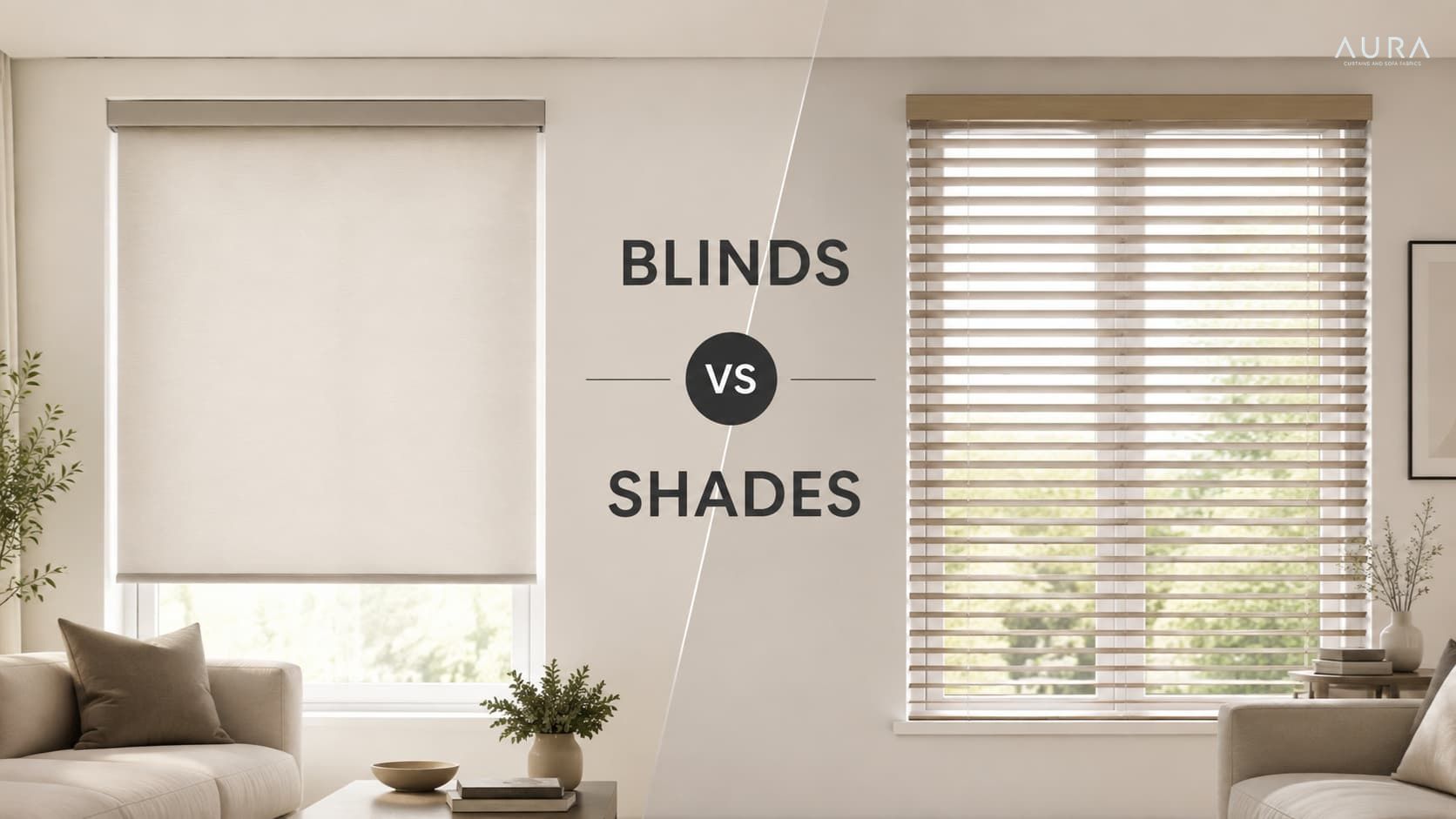
    Blinds and shades are both window coverings, but they’re built differently. Blinds use adjustable horizontal or vertical slats that tilt open and closed, so you control light and privacy without raising the whole covering. Shades are made from a single continuous piece of fabric that rolls, folds, or stacks up as one panel. That construction difference drives every other difference between them — durability, coverage, cost, insulation, and noise reduction.

    This guide from Aura Curtains breaks down exactly how blinds and shades compare, so you can choose the right window treatment for your home.

    Blinds vs Shades: Quick Comparison Table

    Feature Blinds Shades
    Construction Horizontal or vertical hard slats One continuous fabric panel
    Popular types Wood, vertical, aluminum Honeycomb, roller, Roman
    Typical lifespan Longer — hard materials like wood and aluminum generally outlast fabric Shorter — fabric wears, fades, and stains faster than hard slats
    Coverage Partial — small gaps remain between slats even when closed Complete — no gaps, since it’s one solid fabric panel
    Cost Lower upfront, especially aluminum and PVC Higher, especially custom fabrics and blackout linings
    Noise reduction Limited — hard slats don’t absorb sound Better — fabric absorbs sound more than hard materials
    Best for Humid spaces, rental properties, modern/minimalist interiors, commercial settings Bedrooms, media rooms, energy-efficient homes, soft/traditional interiors

    What Are Blinds?

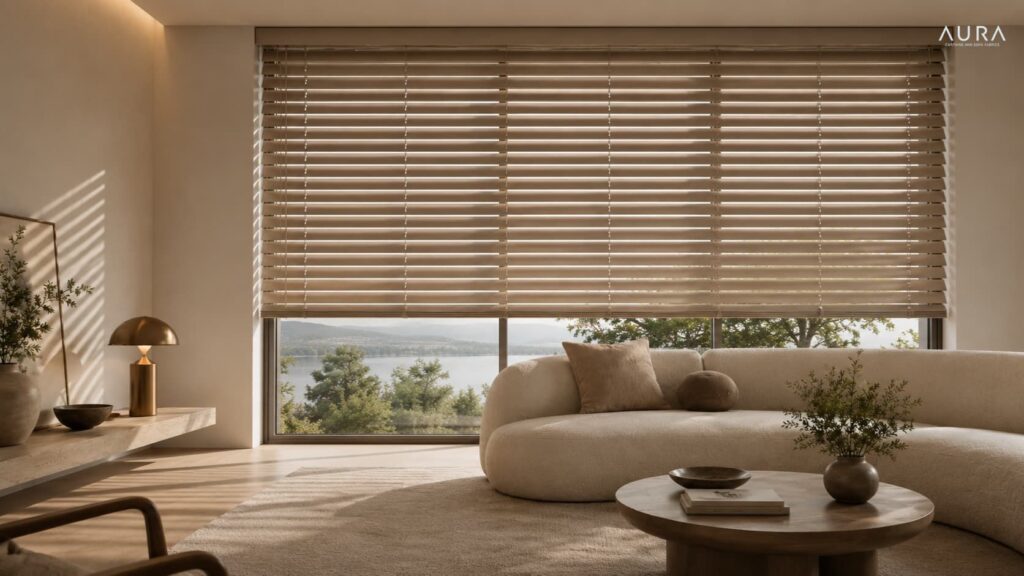
    Blinds are a window covering made of hard horizontal or vertical slats — usually wood, faux wood, aluminum, or vinyl — that tilt open and closed to control light, airflow, and privacy. Unlike shades, blinds don’t need to be fully raised or lowered to adjust how much light enters a room.

     Picture of blinds

    Types of Window Blinds

    Wood blinds have horizontal slats made from real hardwood or faux wood composite. Real wood works best in dry, well-ventilated rooms; faux wood costs less and resists warping in humidity. Best for: living rooms, home offices, bedrooms, well-ventilated kitchens.

    Vertical blinds use long slats — made from vinyl, PVC, or fabric — that run top to bottom and slide open horizontally, making them the standard choice for wide windows and sliding glass doors. Best for: wide windows and tall sliding doors in homes and offices.

    Aluminum blinds have thin horizontal metal slats that resist rust, warping, and cracking, making them a practical choice for bathrooms, kitchens, and other high-moisture rooms where wood and fabric treatments perform poorly. Best for: kitchens, offices, living rooms, bathrooms, laundry rooms.

    Benefits of Blinds

    • Insulation: Blinds reduce heat transfer through the window by acting as a thermal barrier, helping keep indoor temperatures more stable year-round.
    • Ventilation with privacy: Because the slats tilt instead of fully opening, blinds let air circulate without exposing the interior the way an open curtain or shade would.
    • Light and privacy control: Tilting the slats reduces glare and blocks direct UV rays while still letting in daylight, without closing the blinds completely.
    • Low maintenance: Blinds need only occasional dusting or a wipe with a damp cloth to stay clean.
    • Style variety: Blinds come in a range of colors, materials, textures, and slat sizes, adaptable to Scandinavian, minimalist, and biophilic interiors.

    Drawbacks of Blinds

    • Provide poor insulation against outside noise since hard slats don’t absorb sound.
    • Leave small gaps between slats that let some light through even when closed.
    • Offer less noise reduction than fabric shades.
    • Can bend, warp, or crack if handled roughly.
    • Corded blinds pose a safety risk around young children and pets — cordless or motorized versions avoid this.

    What Are Shades?

    Shades are a window covering made from one continuous piece of fabric — mounted on a roller or headrail — that rolls, folds, or stacks up as a single panel when raised. Unlike blinds, shades have no individual slats and no gaps when fully closed.

    Picture of shades

    Types of Window Shades

    Honeycomb shades are made from pleated fabric that forms enclosed, honeycomb-shaped air pockets. Those air pockets trap air between the window and the room, which is why honeycomb shades are considered one of the most energy-efficient window treatments available. Best for: bedrooms, home offices, living rooms, dining rooms.

    Roller shades are a single fabric panel that rolls onto a tube at the top of the window, giving a clean, minimalist look with no folds or pleats when raised. Best for: living rooms, kitchens, bathrooms, dining rooms, bedrooms, offices.

    Roman shades fold into neat horizontal pleats as they’re raised and hang flat when lowered, giving a softer, tailored look than roller shades. Best for: living rooms, bedrooms, kitchens, commercial spaces.

    Benefits of Shades

    • Noise reduction: Fabric absorbs sound better than hard blind slats, making shades a better choice for bedrooms, home offices, and rooms near busy streets.
    • Temperature control: Shades with insulating fabric reduce heat transfer, keeping rooms cooler in summer and warmer in winter.
    • Light and privacy control: Sheer fabrics let in filtered daylight; blackout fabrics block UV rays and glare and give complete privacy.
    • Fabric variety: Shades come in blackout, sheer, linen, and woven fabrics, so you can match function — light-blocking versus filtering — to the room.
    • Aesthetic warmth: The soft, seamless fabric panel adds a warmer look than hard slats, suiting traditional and luxury interiors.

    Drawbacks of Shades

    • Custom, high-quality shades cost more than most blinds.
    • Not well suited to high-moisture rooms like bathrooms — fabric absorbs moisture that hard materials shed.
    • Collect dust and stains faster than blinds.
    • Fabric fades over time with prolonged UV exposure.
    • Wear and tear happens faster than with wood, aluminum, or PVC blinds.

    How to Choose Between Blinds and Shades

    • If durability and personalized light control matter most → choose blinds. If soft aesthetics and full window coverage matter most → choose shades.
    • If you need zero-gap coverage (a media room, nursery, or bedroom needing full blackout) → choose shades. Blinds always leave small gaps between slats.
    • If your interior is modern, industrial, Scandinavian, or minimalist → blinds tend to match better. If it’s traditional, contemporary, or luxury-styled → shades tend to match better.
    • If budget is the main constraint → aluminum or PVC blinds are the cheaper option. Custom fabric shades cost more due to premium materials and made-to-measure production.

    Conclusion

    In short: blinds offer more durability, easier light control, and a lower price point; shades offer complete coverage, better noise reduction, and a softer look — at a higher cost. The right choice depends on the room, your climate, and your budget.

    If you’re looking for blinds or shades in Dubai, Aura Curtains supplies and installs a full range of window treatments across the UAE, tailored to your space and style.

    FAQs

    Which is more budget-friendly: blinds or shades?

    Blinds are usually cheaper than shades because they use simpler materials like aluminum and PVC, while shades — especially custom fabric ones — cost more.

    What do blinds and shades have in common?

    Both blinds and shades are window coverings that control sunlight, improve privacy, help regulate indoor temperature, and enhance interior style.

    Do I need a professional to install blinds and shades?

    For accurate measurements, secure mounting, and smooth operation, professional installation is recommended over DIY.

    Which lasts longer, blinds or shades?

    Blinds generally last longer because materials like wood, aluminum, and PVC hold up better over time than the fabric shades are made from.

    Why are custom shades more expensive than standard blinds?

    Custom shades cost more because they require precise measurements, premium fabrics, and specialized manufacturing and installation for an exact fit.

    Can I use blinds and shades together in the same room?

     Yes. Layering a shade behind a blind, or vice versa, is common when a room needs both flexible daytime light control and complete blackout or privacy at night.

    Are blinds or shades better for a bathroom?

    Blinds — specifically aluminum or PVC — are better for bathrooms because they resist moisture, while fabric shades can absorb humidity and are more prone to mold and staining.

  • Curtains over Blinds Ideas: Guide to  A Stylish and Practical Window Look

    Curtains over Blinds Ideas: Guide to A Stylish and Practical Window Look

    Windows are not just openings in your home, but are design statements.

    When it comes to dressing them, blinds or curtains are a never-ending debate. But what if we look for curtains over blinds ideas? Will it serve functionality and aesthetics?

    Mixing curtains and blinds brings functionality and aesthetics, elevating the interior of your place. You can add blackout curtains with roller blinds in your bedroom for privacy and darkness. Vertical blinds with neutral curtains will lift the aesthetics of a home office.

    You need to know the best combinations, or else your set goals will look like a disaster.

    How will Curtains over Blinds Ideas Benefit me?

    Curtains over Blinds Ideas

    Combining curtains and blinds together is a popular trend, and this is for a good reason. While window blinds offer clean lines and practical light control, the curtains will bring softness, texture, and warmth to a room. A combination of curtains over blinds ideas will create a layered look that is both stylish and versatile.

    Some other reasons you can consider this combination:

    • Light control: Blinds allow you to adjust light levels precisely, while curtains add blackout or diffused options.
    • Privacy: Keeping the blinds down for privacy during the day and pulling curtains at night for a complete enclosure.
    • Energy efficiency: The added layer can help insulate your room against heat and cold.
    • Aesthetic value: The combination will add dimensions and richness to your interior design.

    Types of Curtains and Blinds

    Types of Curtains and Blinds

    Before you explore some of the best curtains over blinds ideas that can be combined for an appealing look. You must know about some of the available options to help you make choices that align with your home’s look and lifestyle needs.

    • Types of Curtains

    Types of Curtains Reasons You can Choose these
    Sheer Curtains Light and airy, perfect for soft light filtering.
    Blackout Curtains  Thick and opaque, ideal for bedrooms and media rooms.
    Eyelet Curtains  Easy to slide and install, giving a modern appearance.
    Pinch Pleat Curtains Elegant and structured, suitable for formal spaces.
    Rod-pocket Curtains Casual and relaxed, great for informal settings.
    • Types of Blinds

    Types of Blinds Reasons You can Choose these
    Roman Blinds  Fabric blinds fold neatly when raised, perfect for a tailored look.
    Roller Blinds  Minimalist and space-saving, available in light-filtering or blackout options.
    Venetian Blinds  Horizontal slats that tilt for light control, often made of wood or metal.
    Vertical Blinds  Great for large windows or sliding doors, practical and easy to adjust.
    Honeycomb Blinds  Energy-efficient and excellent for insulation.

    Each of the styles has its own advantages, and the beauty of mixing them lies in the harmony between them.

    Which Curtains and Blinds will Bring Aesthetics to My Space?

    Designers have worked with various curtain and blind combos. Some turned out to be successful, while others were weird ones. You can choose sheer curtains and combine them with roller blinds, or combine rod-pocket curtains and honeycomb blinds.

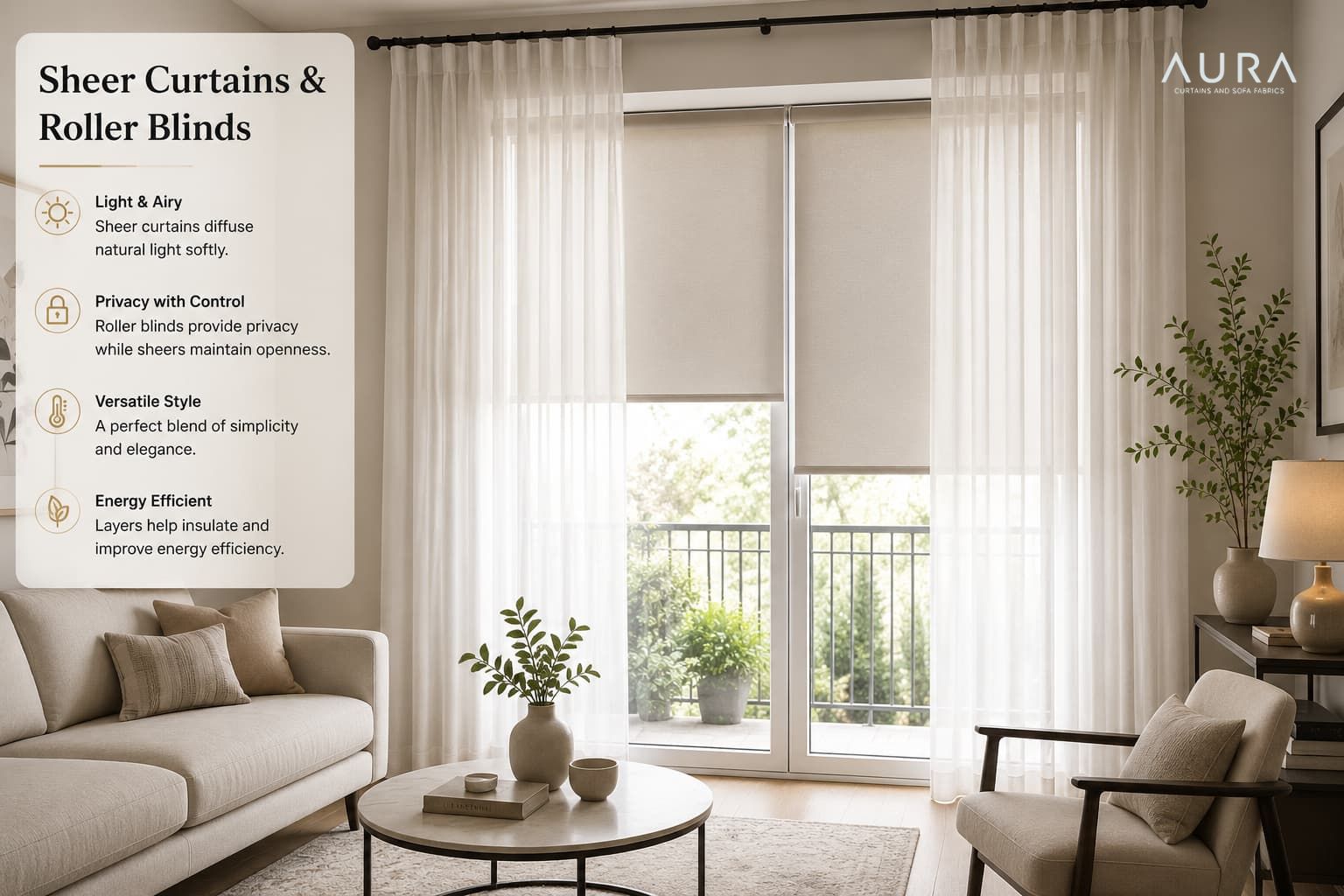
    • Sheer Curtains & Roller Blinds

    Sheer Curtains & Roller Blinds

    This combo works well, as you can keep the blinds drawn during the day for UV protection and close the curtains in the evening for ambience.

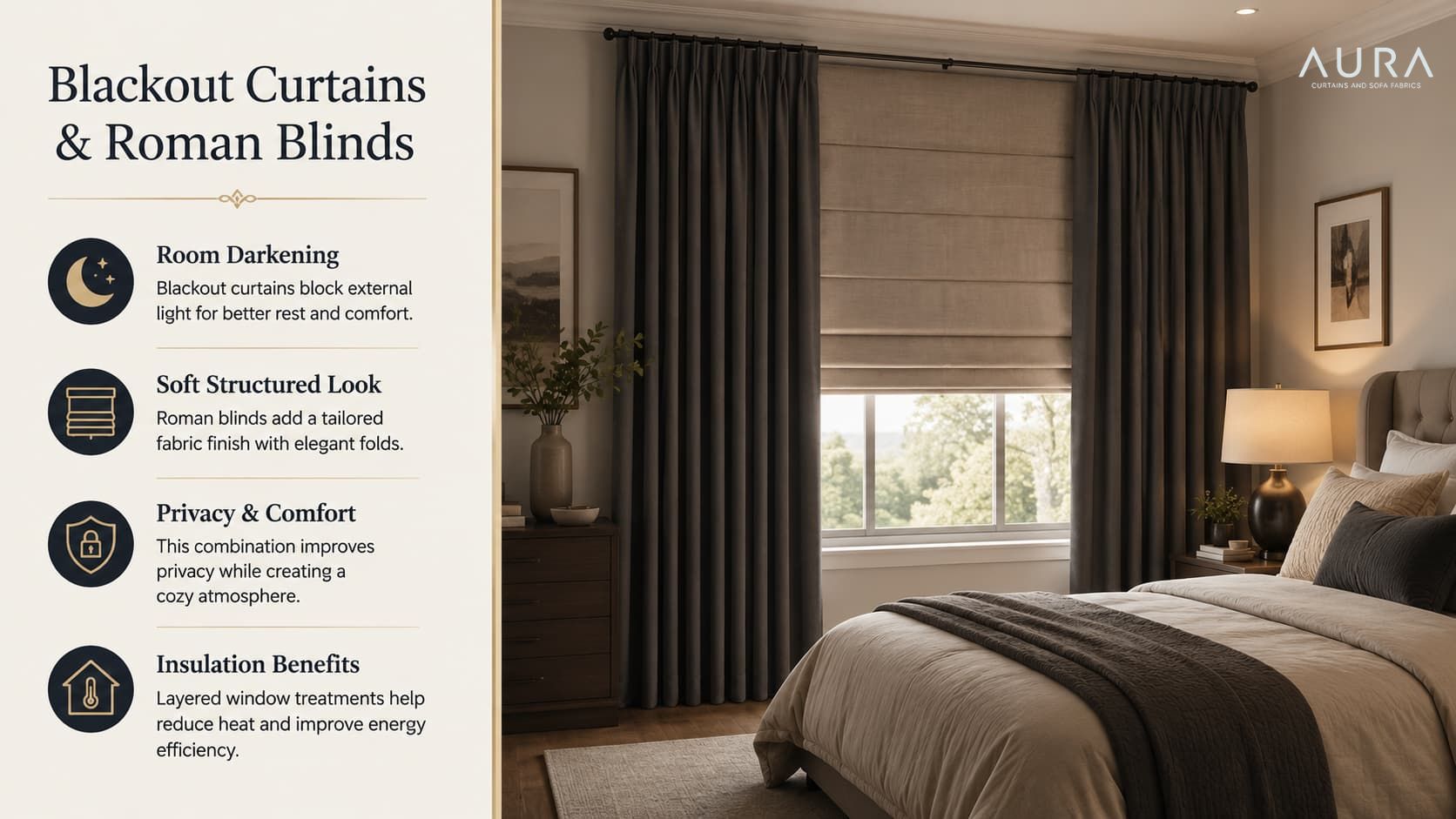
    • Blackout Curtains & Roman Blinds

    Blackout Curtains & Roman Blinds

    If you aim to block out light at night and gently filter the UV rays during the day, then choose this mixture.

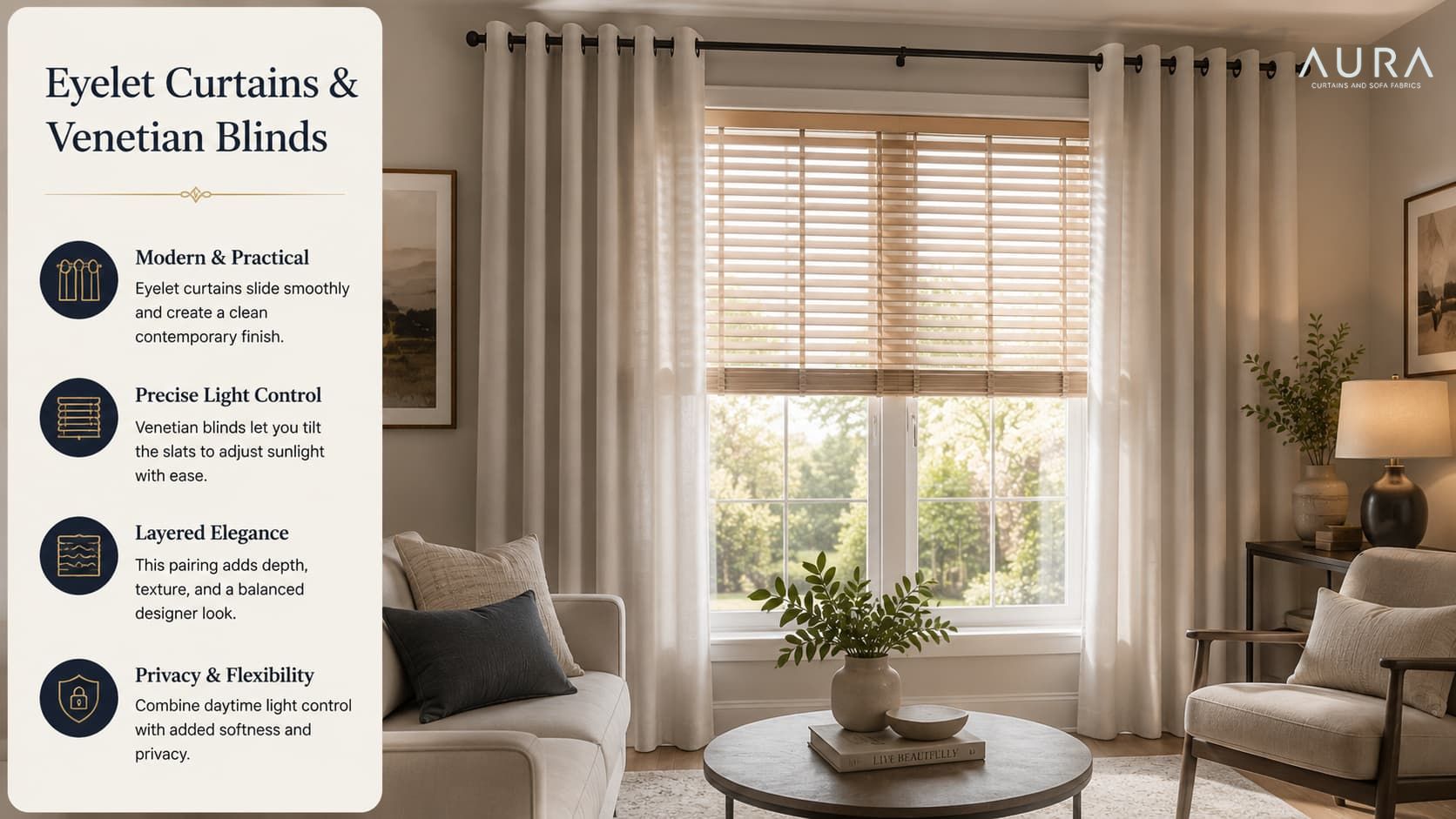
    • Eyelet Curtains & Venetian Blinds

    Eyelet Curtains & Venetian Blinds

    Venetian blinds are made of faux wood or aluminium that are easy to clean, and layering them with eyelet curtains gives a modern, cozy, and practical look.

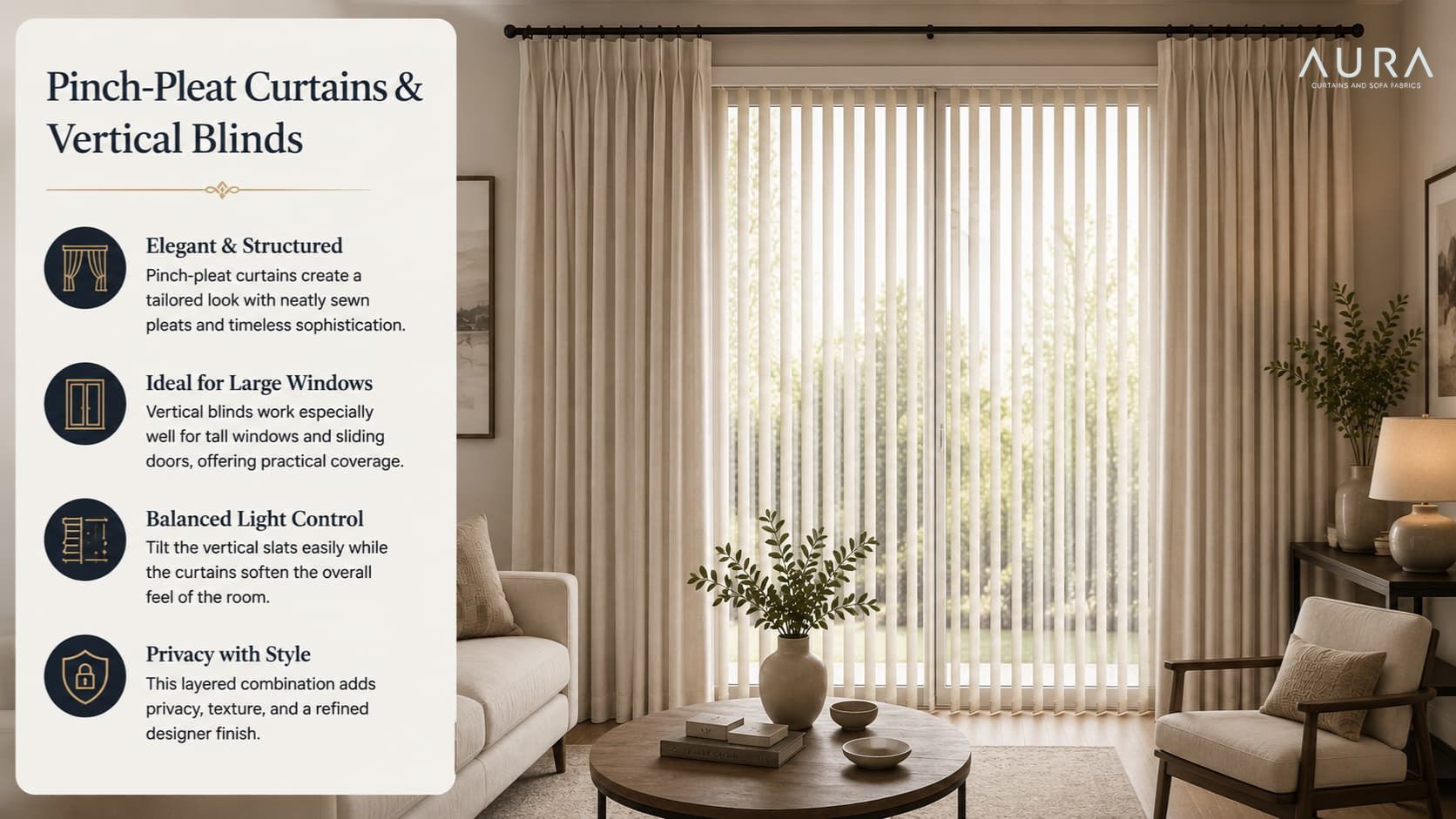
    • Pinch-Pleat Curtains & Vertical Blinds

    Pinch-Pleat Curtains & Vertical Blinds

    Pinch-pleat curtains and vertical blinds are a perfect choice as they reduce glare and add sophistication.

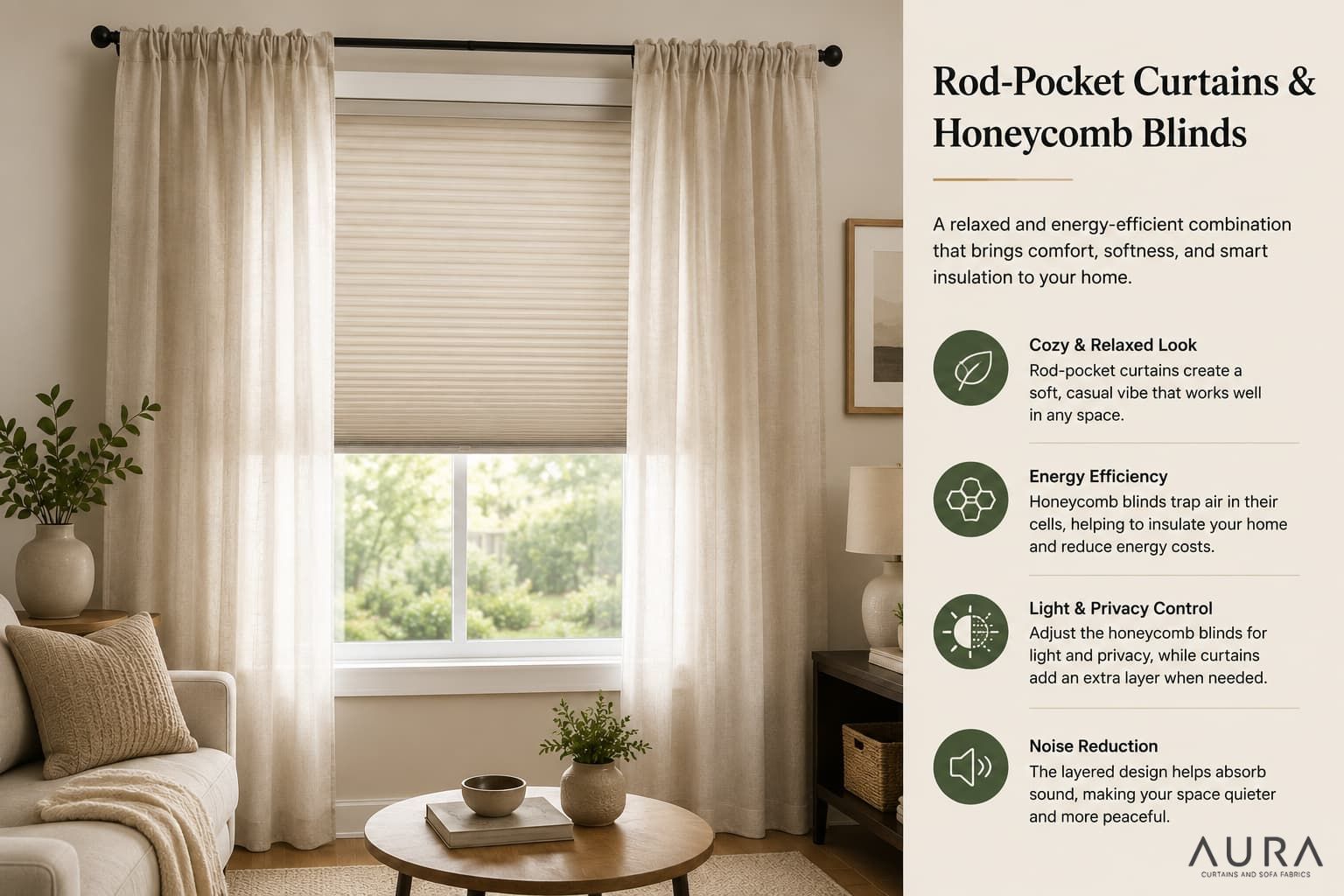
    • Rod-Pocket Curtains & Honeycomb Blinds

    Rod-Pocket Curtains & Honeycomb Blinds

    This pair creates a highly functional and visually appealing window treatment by trapping air to block heat and adding an extra layer of thermal protection.

    Ideal Places Where These Combos Will Work

    Each room serves a different purpose and requires a tailored approach when mixing curtains and blinds ideas. Explore some room-specific ideas.

    • Living Room

    For a stylish living room, you can combine sheer curtains with roller blinds. Make sure that you choose colors that complement your upholstery and wall tones.

    • Bedroom

    Bedrooms can be best designed with blackout curtains and roman blinds. But you need to choose soft textures for calming hues in sleeping spaces.

    • Kitchen

    Kitchens of the house are the space that needs the most cleaning while giving a cozy and practical look. Venetian blinds and eyelet curtains will work best.

    • Home Office

    Home offices mean minimum screen reflections and more privacy for video calls. This can be achieved by adding pinch-pleat curtains and vertical blinds.

    • Home Theater

    Your home theater is a place that cannot be ignored. Using rod-pocket curtains and honeycomb blinds will work. The blinds will work as light-filtering during the day, and curtains will provide extra thermal protection.

    6 Mistakes that can Prevent You from Achieving the Set Goals

    Below are the 6 mistakes that must be prevented if you want to achieve your set goals and not turn the combinations into a disaster.

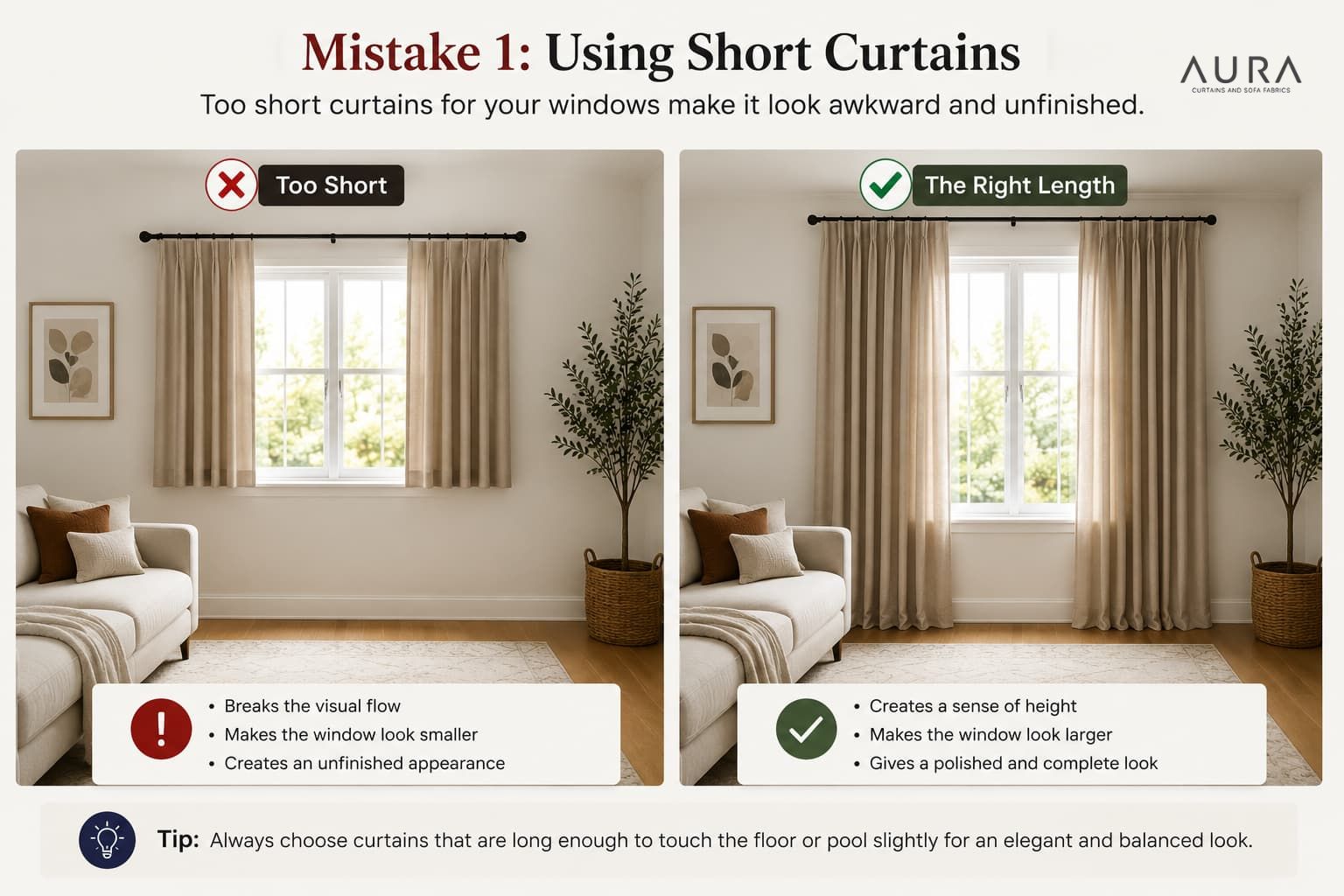
    Mistake 1: Using short curtains

    Too short curtains for your windows make it look awkward and unfinished.

    Using short curtains

    Tip:

    Use a size that falls neatly and covers the space well.

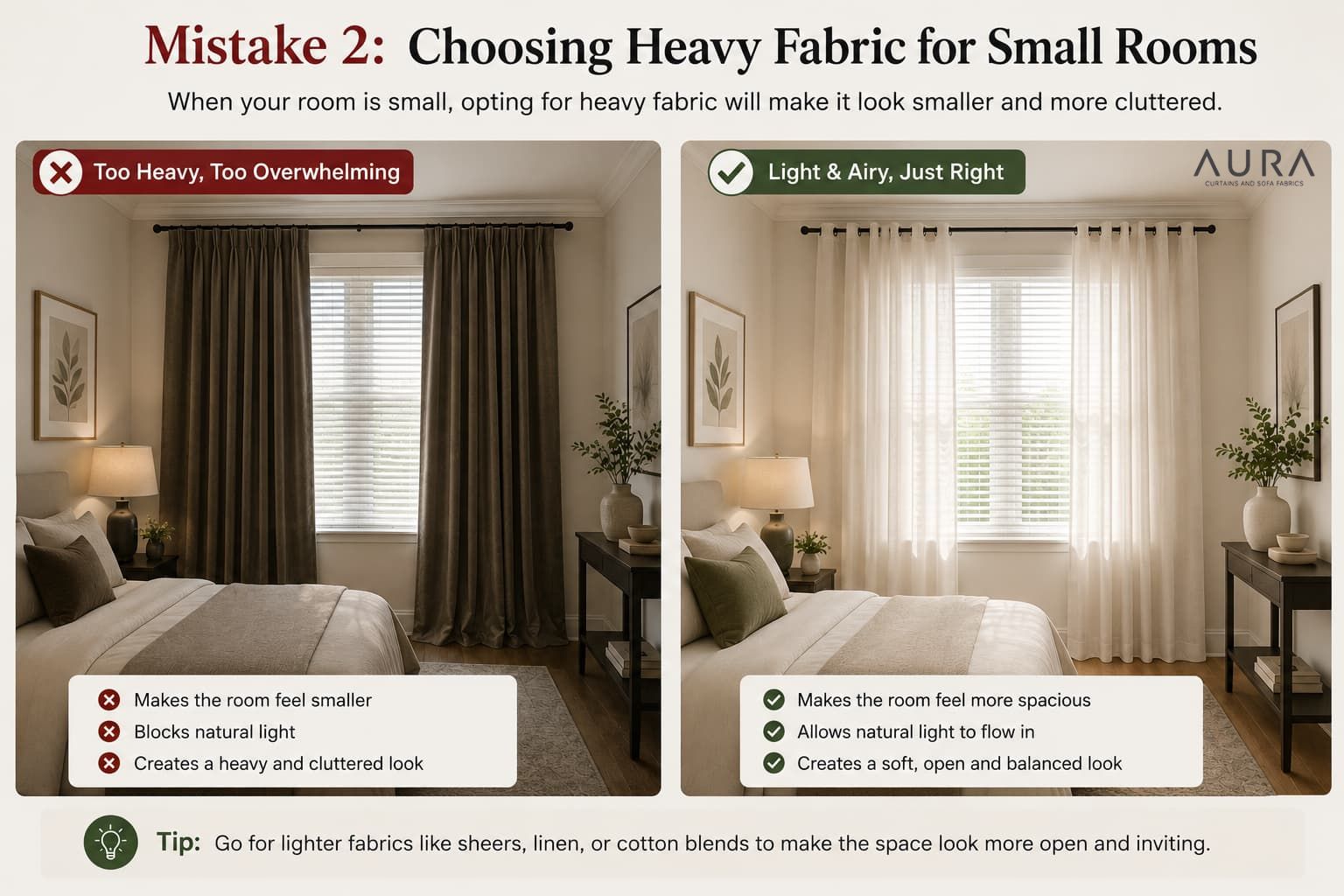
    Mistake 2: Choosing heavy fabric for small rooms

    When your room is small, opting for heavy fabric will make it look smaller and more cluttered.

    heavy fabric for small rooms

    Tip:

    Go for lighter fabrics so it can make the space look more open.

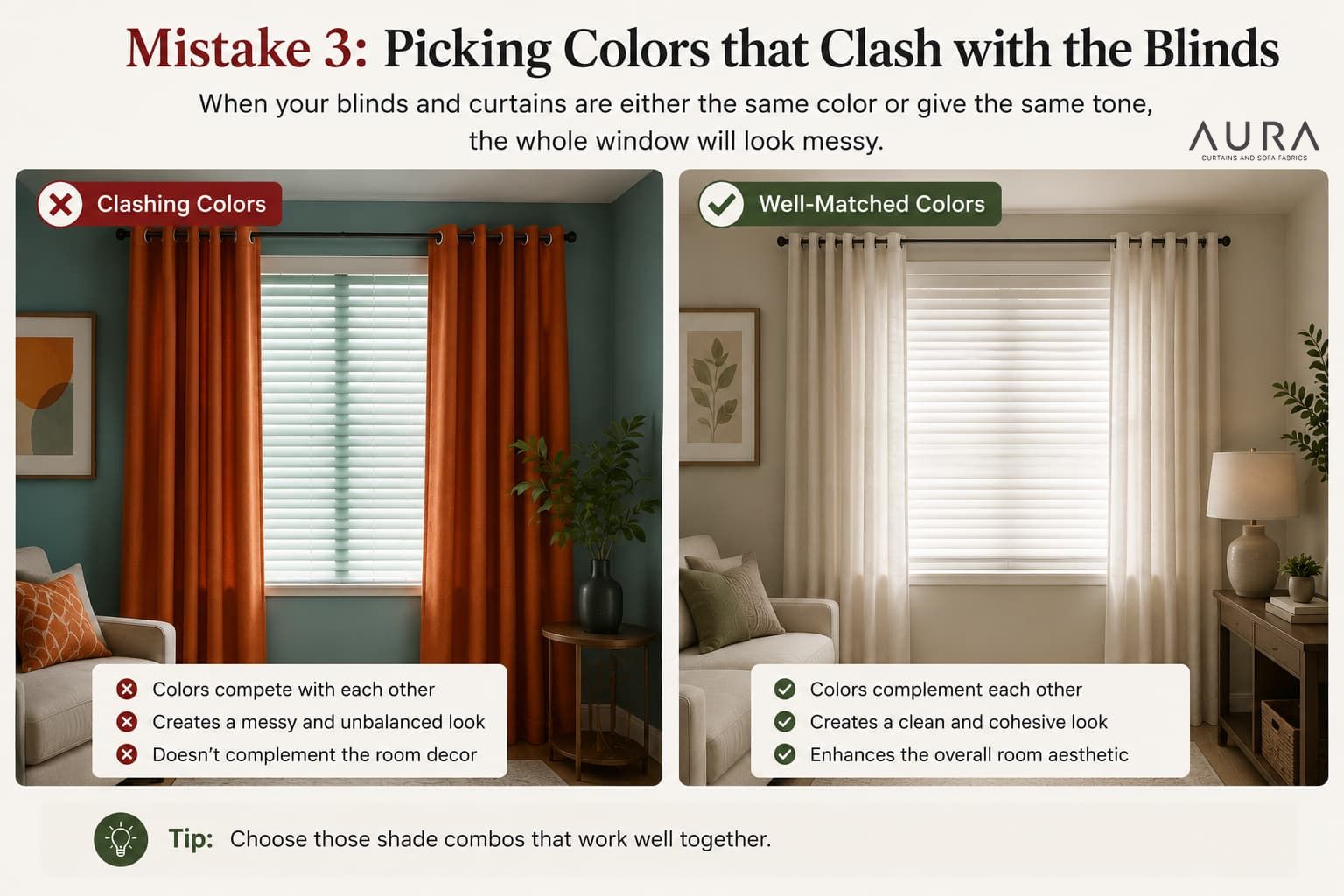
    Mistake 3: Picking colors that clash with the blinds

    When your blinds and curtains are either the same color or give the same tone, the whole window will look messy.

    colors that clash with the blinds

    Tip:

    Choose those shade combos that work well together.

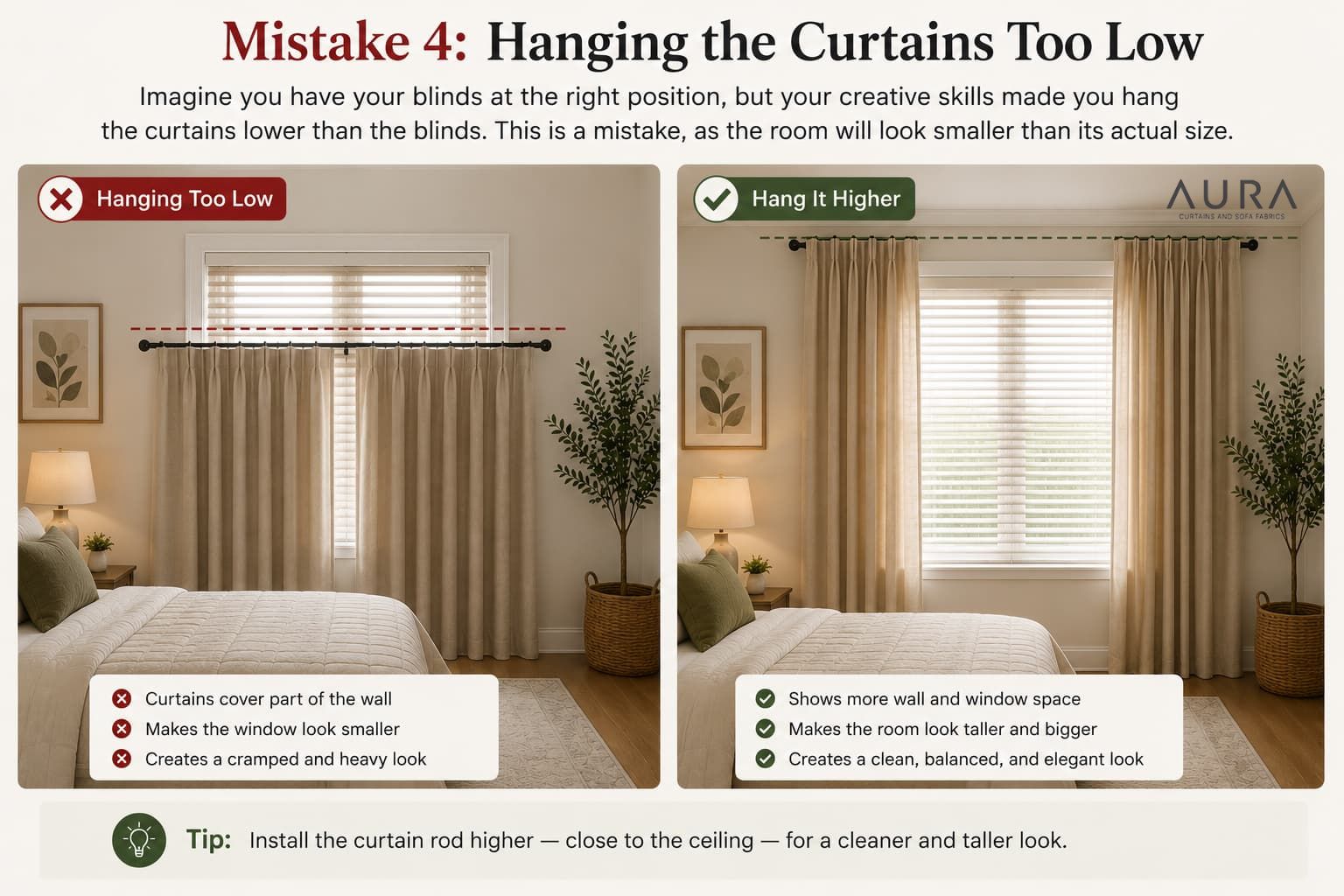
    Mistake 4: Hanging the curtains too low

    Imagine you have your blinds at the right position, but your creative skills made you hang the curtains lower than the blinds. This is a mistake, as the room will look smaller than its actual size.

    Hanging the curtains too low

    Tip:

    Install the curtain rod higher for a cleaner and taller look.

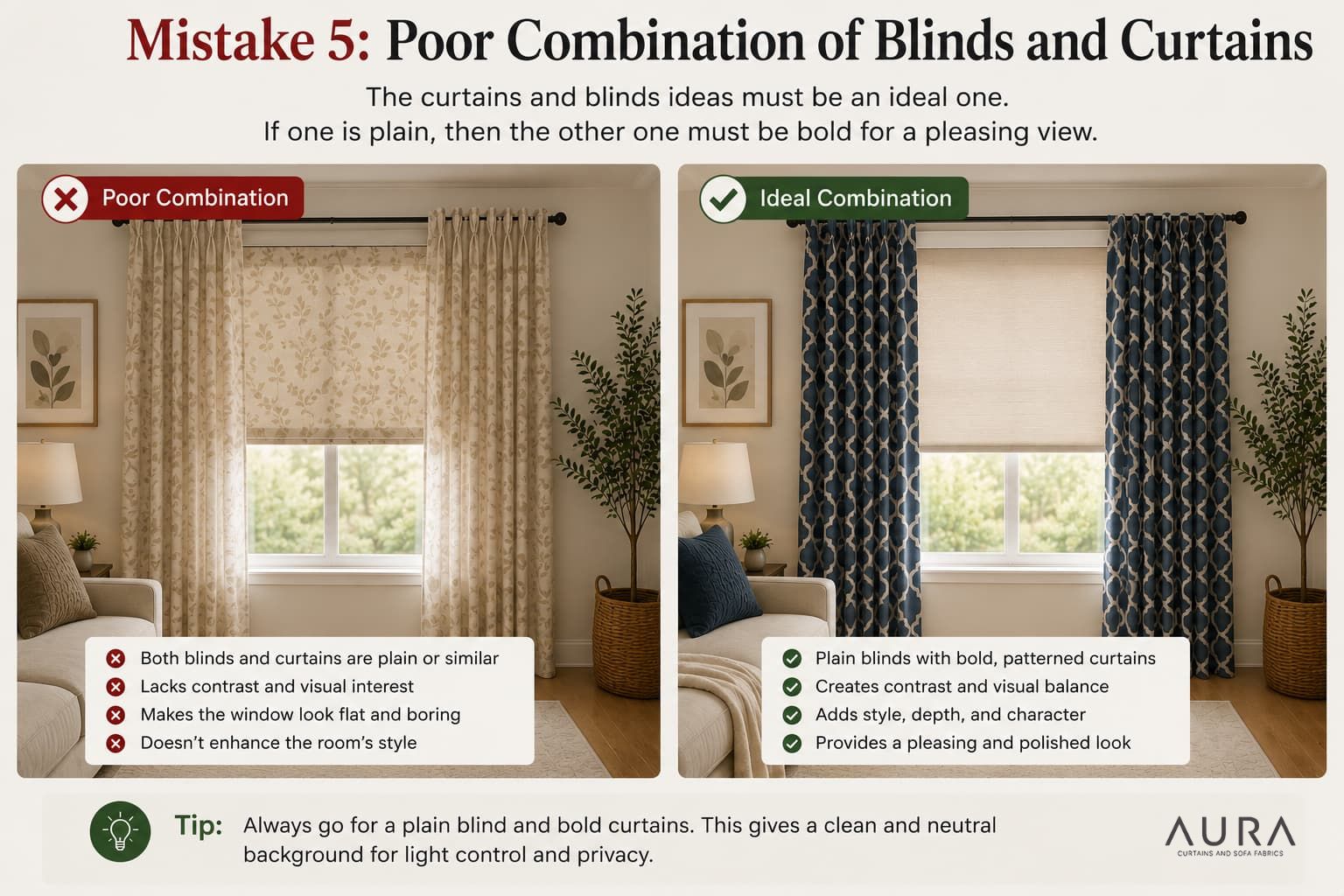
    Mistake 5: Poor combination of blinds and curtains

    The curtains and blinds ideas must be an ideal one. If one is plain, then the other one must be bold for a pleasing view.

    Poor combination of blinds and curtains

    Tip:

    Always go for a plain blind and bold curtains. This gives a clean and neutral background for light control and privacy.

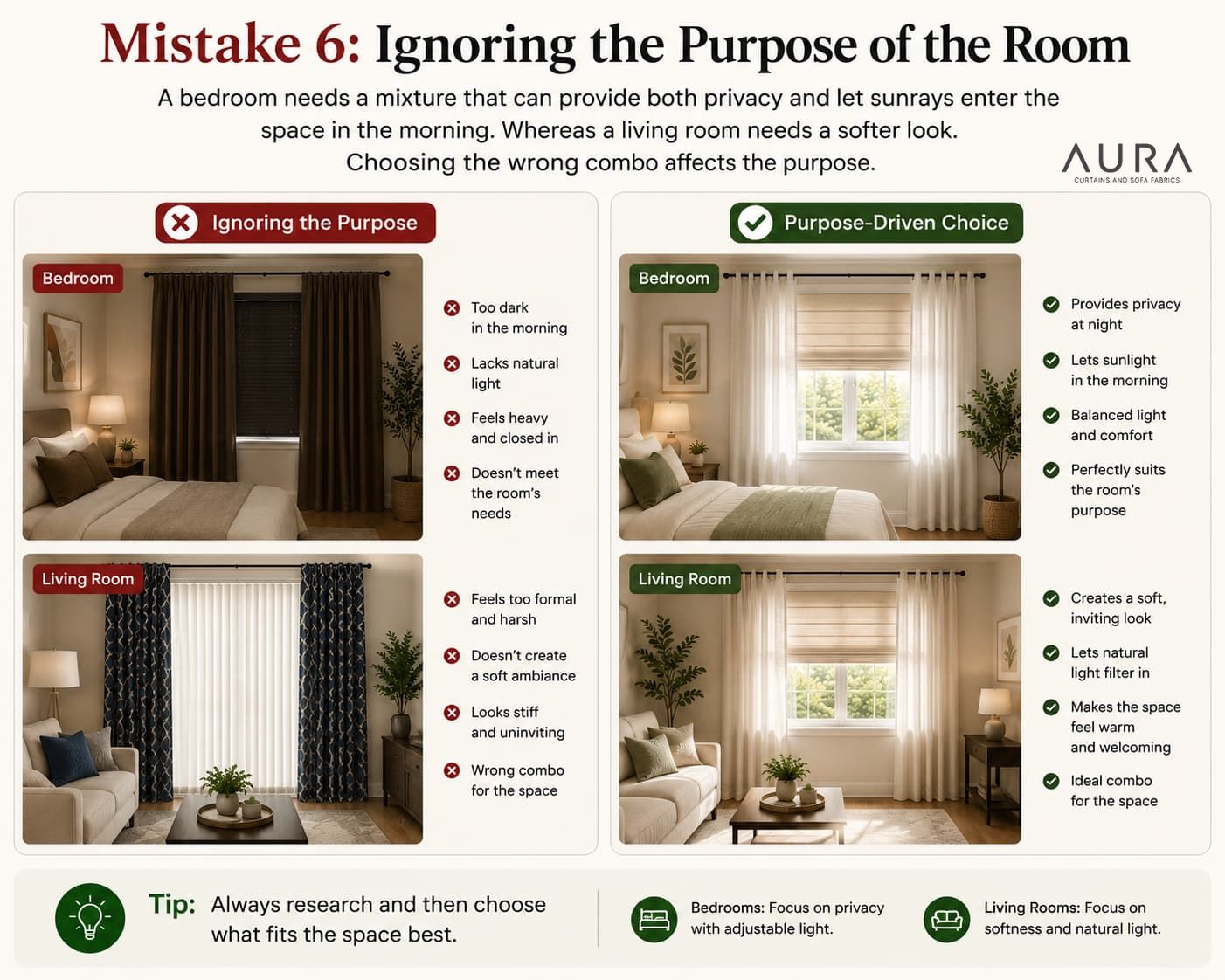
    Mistake 6: Ignoring the purpose of the room

    A bedroom needs a mixture that can provide both privacy and let sunrays enter the space in the morning. Whereas a living room needs a softer look. Choosing the wrong combo affects the purpose.

    Ignoring the purpose of the room

    Tip:

    Always research and then choose what fits the space best.

    Conclusion

    Curtains over blinds ideas can make your room look stylish and feel more comfortable. This combination helps with better light control, more privacy, and a softer finish. The key is to choose the right pair for each room of your house. Make sure the color palette is balanced, the fabric fits the room, and the size is perfect for the window. The right mixture will make your window look beautiful and work better too.

    FAQs

    Can I use curtains over blinds in any room?

    Yes, you can. It works in bedrooms, living rooms, offices, and even kitchens. Just choose the right fabric and style for the space.

    Are curtains over blinds good for privacy?

    Yes, they are. Blinds give daytime privacy, and curtains add extra coverage at night. Together, they work very well.

    Which blind and curtain combo looks most modern?

    A plain roller blind with bold curtains is a great choice. It looks clean, stylish, and easy to match with most rooms.

     Do curtains over blinds make a room darker?

    They can, if you choose blackout fabrics. This is helpful in bedrooms and media rooms where you want less light.

    How do I choose the right colors?

    Pick colors that match the room’s mood. Soft tones feel calm, while bold colors add personality. Try to keep the look balanced and simple.

  • What To Do When Cordless Blinds Won’t Go Up

    What To Do When Cordless Blinds Won’t Go Up

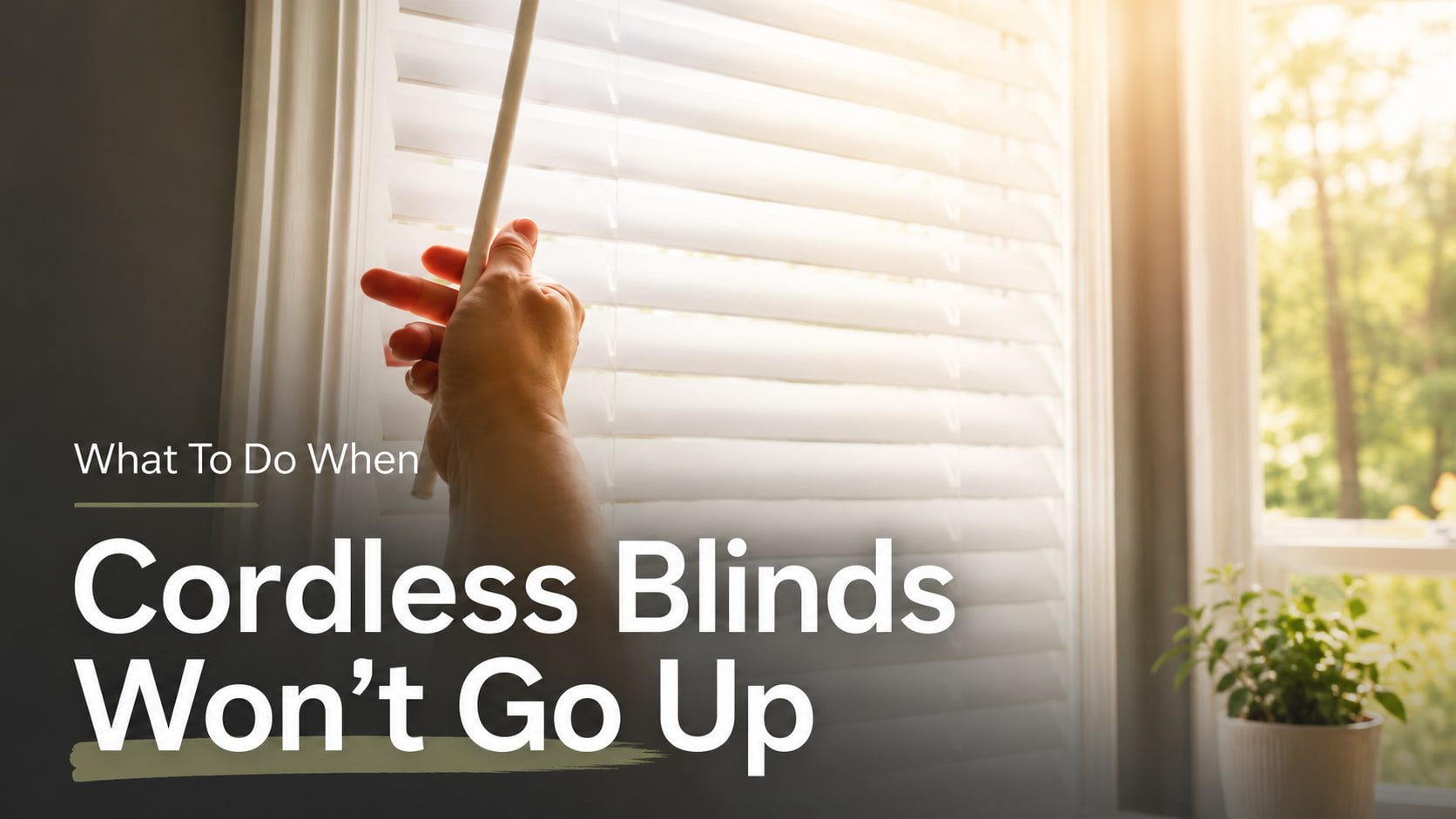
    Pulling gently on the bottom rail of your cordless blinds, you expect them to glide upwards smoothly, but instead, they drop back down. This is something common.

    Cordless blinds are becoming common among homeowners due to their exceptional quality that reduces the risk of injuries. They have hidden mechanisms that help the blinds go up and down.

    But what are some of the reasons that cordless blinds won’t go up? Do machines fail? The internal springs can lose their tension, or the safety locks can get jammed. So what should a person do in this situation? They should either remove the blind from the mounting brackets or clean thoroughly with a vacuum brush. Each cordless blind can be fixed using a different method.

    What are Cordless Blinds?

    Cordless blinds, often known as string-less blinds, are the window coverings that don’t have a string hung along with the blinds for their operation. Instead of string, these blinds use a hidden spring or tension mechanism inside the bar. To raise or lower them, you simply need to pull or push the bottom rail with your hands.

    4 Reasons and Their Solution if Your Cordless Blind is Not Operating Well

    It is no surprise that the highest-quality cordless blinds stop working over time. Some of the most frequent problems people complain about and the ways you can resolve them are listed below.

    • Blinds don’t go up or don’t stay up

    A common issue with cordless blinds is that they either drop back immediately when you try to raise them, or they don’t go up at all when you lift them.

    Reason for this issue:

    The main issue is with the strong tension. The internal springs installed to operate the blinds lose their tension. This happens if they are frequently used or are exposed to higher temperatures.

    The possible solution:

    Most of the cordless blinds have a tension adjustment. You just need to remove the blind from the mounting brackets and examine the headrail ends. Turn the screws or rotate the pin to increase tension.

    • Spring tension and friction issues

    If you need to apply a lot of force to raise and lower the blinds, this means either the spring tension may be too tight, or friction within the mechanism might be causing resistance.

    Reason for this issue:

    If this occurs after you have installed your blinds, then this means the factory setting is not matching your specific blind size or weight. It can be that the spring has shifted from its optimal position. Sometimes, the dust and debris can even create friction in moving parts.

    The possible solution:

    Locate the tension adjustment mechanism on your blind headrail. Then adjust the tension by rotating the gear gently. Ask your manufacturer for the number of rotations.

    • Stuck blinds and jamming

    Another situation can be that your blinds move some way up and down, and then get jammed or stuck in a place. With extra force, the blind refuses to budge.

    Reason for this issue:

    Debris accumulation, fabric bunching, or misaligned components within the headrail can cause jamming.

    The possible solution:

    Repairing it is simple. Just fully lower the blinds and inspect the side channels and headrail for dust, pet hairs, or debris. Clean it with a vacuum brush.

    • Uneven raising or one side higher

    The last issue can be that one side of the blind raises higher than the other. This creates an uneven appearance that affects both functionality and aesthetic appeal.

    Reason for this issue:

    It can be the uneven spring tension on either side of the blind, a bent bottom rail or misaligned clips in the headrail.

    The possible solution:

    Ensure that the blind is seated properly in both mounting brackets. Remove and reinstall if necessary, ensuring the headrail clicks securely into place. Inspect the bottom rail for bends or warping. Apply gentle pressure to straighten any minor bends.

    Possible Solutions According to the Blind Types

    Types of Cordless Blinds Possible Solution
    Roller Blinds Locate the pin at one end of the rail and pull the shade down. Remove it from the brackets. Roll the fabric manually sometimes and then reinstall.
    Venetian Blinds You need to check the cord lock mechanism inside the headrail. Clean any debris and ensure the internal components move freely without obstruction.
    Vertical Blinds Inspect each slat and clip to ensure they align properly on the track. Gently realign any slats that are twisted or bent. Check the rod mechanism that controls the vertical movement and ensure it rotates smoothly.
    Cellular or Honeycomb Blinds There is a white gear or clip visible when you remove the end cap. Just rotate the gear gently and check if the blinds work.

    Maintenance Tips for Cordless Blinds for Longevity

    Consistent routine cleaning is important for maintaining the pristine appearance and smooth operation of your cordless blinds. Regular maintenance keeps them looking new and prevents dust and grime buildup from affecting internal mechanisms.

    • Dusting tools: Use a feather duster, microfiber cloth, or a vacuum cleaner’s brush on low setting to remove loose dust and debris.
    • Gentle cleaning solution: For deep cleaning, prepare a solution of mild soap and warm water. Avoid harsh chemicals or excessive moisture.
    • Spot cleaning: Address spills immediately using a damp cloth with a small amount of gentle cleaning solution. Dab gently to prevent spreading the stain.
    • Wiping direction: Always wipe blinds horizontally across the slats or fabrics, following the material’s grain.
    • Drying: Allow cordless blinds to air dry completely after cleaning before raising them.

    Conclusion

    Your cordless blinds not working normally is fine, and there are some simple reasons. All these problems are easy to fix. In most of the cases, a little cleaning, adjusting the tension, or quickly resetting it will make it work perfectly. Additionally, you need to work on their regular care to keep them running smoothly for a longer time.

    FAQs

    Why do cordless blinds stop going up?

    This usually happens when the spring tension gets weak or the mechanism gets stuck. A small adjustment or cleaning often helps.

    Can I fix cordless blinds myself?

    Yes, in many cases you can. Simple issues like dust, tension, or misalignment are often easy to handle at home.

    How often should I clean cordless blinds?

    Light cleaning once a week is a good idea. A deeper clean every few months can help keep them working well.

    Are cordless blinds safer than regular blinds?

    Yes, they are. They do not have hanging cords, so they are safer for children and pets.

    When should I replace my cordless blinds?

    If they stay stuck, feel damaged, or no longer work after fixing, it may be time to replace them.

  • How many Curtain Rings Per Panel

    How many Curtain Rings Per Panel

    Do you feel that your curtains look uneven, too tight, or not enough? The problem is the number of rings you have used. 

    The number of rings you use per panel depends on factors such as the curtain rod length, the width or fullness of the drapery panels, and the weight of the fabric. Using too few will make your curtains sag, while using too many makes them look cluttered. 

    When styling a cozy living room or a modern office, it’s important to understand how many curtain rings per panel are needed to achieve the look you want. 

    The Basics of Hanging the Curtains the Right Way 

    Hanging curtains looks simple on surface level, but minor details make a huge difference in your home. One of the important elements that changes the look is the curtain rings. They are the connection between your fabric and the rod, allowing you to open and close your curtains smoothly.  

    What is the Ideal Number of Curtain Rings Per Panel? 

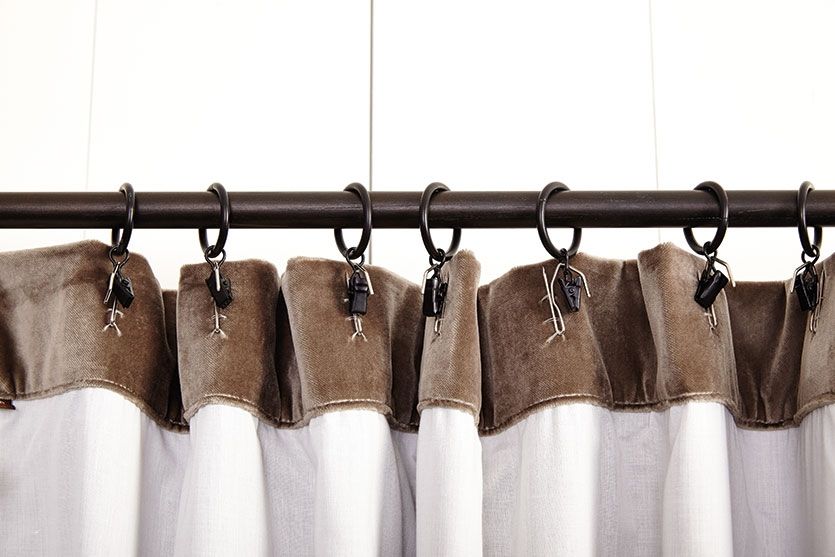
    The ideal number of rings depends on the size of the curtain, the weight of the fabric, and the way you want it to look. A general rule is one ring every 4 to 6 inches across the top of the panel.

    3 Steps to Calculate the Number of Rings 

    You can calculate how many rings per curtain panel in a simple way. 

    • Measure the width 

    You should begin by measuring the width of your curtain panel. These measurements will help determine how many rings are needed to space evenly along the rod. 

    • Check for the curtain style 

    The style of the curtain is important. Check if it is a flat panel, pinch pleat, or other kind of curtain. The style determines the way rings must be placed. 

    • Consider the fullness 

    The fullness of the drapery panels affects the number of rings that are needed. More fullness means more fabric. This shows more rings are necessary to keep the drapery from dropping. 

    This formula keeps folds even and the curtain hanging straight. 

    How Far Apart should Curtain Rings be? 

    Another important detail that you need to check when hanging curtains is creating a balance and symmetry. Most of the experts recommend placing each curtain ring about four to six inches apart. This equal distance allows the fabric to fall into gentle, natural folds without stretching too tightly or bunching unevenly. 

    How to measure the distance 

    This image is being created using ChatGPT. 

    To measure the spacing accurately, you must begin by laying your curtain flat on a clean surface. Measure its total width, then set aside about two inches on each end to leave room for the edge rings. Divide the remaining width by the number of spaces between the rings to find the correct distance. 

    Take your time to measure carefully before hanging your curtains. This ensures a professional finish. When each ring is evenly spread, the curtain hangs straight, opens easily, and looks clean and intentional from every angle. 

    Style guide: Pleated, Flat, or Grommet Curtains with Rings 

    Different curtain styles use different approaches for curtain rings. 

    • Flat-panel Drapery: These are unpleated curtains that rely on ring spacing to create their shape. Adding 8-10 rings creates soft, natural waves. 
    • Pleated Drapes: Each pleat needs its own ring, plus one extra at the end. For instance, if your curtain has 9 pleats, you will be using 11 rings.
    • Grommet Curtains: They have built-in holes, so you just thread them through the rod with no extra rings needed.
    • Sheer Curtains: As a lightweight fabric, they will look best with fewer rings spaced wider apart, about every 6 inches. 
    • Blackout Curtains: Heavy fabrics need more rings, with one ring after every 4 inches. This gives them support to hang straight on the rod. 

    If you are mixing different curtain styles in one room, make sure that the ring finish is consistent. This gives the design a visually appealing look. 

    Conclusion 

    Choosing how many curtain clips per panel may seem like a small task, but this makes a huge difference. It helps your curtains to hang neatly, move smoothly, and look balanced. There is no fixed number of curtain rings, but it depends on the fabric, style, and the width of the panel. You need to place them clearly for your curtains to look more polished and finished. You just need to invest some time in collecting the right measurements. 

    FAQs 

    Are curtain rings easy to adjust after hanging?

    Yes, in most cases. You can move them a little to improve the spacing and make the curtain hang better. 

    Can curtain rings change how a room looks?

    Yes. Well-spaced rings help curtains look neat, full, and polished. This can make the whole room feel more finished. 

    Which rings are better, metal or wooden? 

    Both of them work well. Metal rings are durable and modern. Wooden rings create a warmer and more traditional look. 

    Can I use the same number of rings for every curtain panel?

    Not always. Some panels need more support than others, especially if the fabric is heavier or wider.

    Do curtain rings affect how easy the curtains are to open?

    Yes. The right number of rings helps the curtains slide smoothly and keeps them from getting stuck.

    Should the ring finish match other decor in the room?

    It is a good idea. Matching the finish helps the curtains look more styled and put together.

  • Best Type of Blinds for Living Room

    Best Type of Blinds for Living Room

    The kitchen is the heart of your home, and the living room is the soul.

    Finding the right type of blinds for your living room can be tricky. Choosing between custom, ready-made, wooden, fabric, blackout, or sheer blinds depends on your space’s style.

    When choosing the best type of blinds for living room windows, first consider your room and how you want your window treatments to enhance the space.

    Tips to Choose the Best Blinds for Living Room Windows

    Image:

    When deciding on living room blinds windows, it is important to take your specific needs and preferences into consideration. From light and privacy control to insulation to functionality, you need to consider these factors to help you guide you towards the right blinds.

    Natural light

    Do you get a lot of sunlight, or very little? Are you concerned about the sun bleaching your furnishings? Do you need heat control or glare reduction? All blinds and shades will block light when closed, but some, like solar shades, will let some sun rays through. This insulates your room against heat, reduces glare, and prevents fading of your furnishings.

    Privacy needs

    Is your living room window street-facing where there are a lot of passersby? Do any windows clearly face your neighbors? What is your level of privacy concern? Different blinds for living room offer varying levels of privacy. Solar shades provide minimum privacy, while wood blinds and blackout-lined roman shades offer maximum privacy.

    Insulation

    Do your living room windows have a draft in winter or let in the heat during summer? There are some blinds that are better at insulating than others. Cellular shades trap both heat and cold air in their unique cells for more temperate indoor temperatures.

    Window size

    The living room blinds for larger windows will be different from those for small or narrow windows. For instance, your tall or wide living room windows will benefit from motorized shades or blinds that can lift with the press of a button or a remote. For smaller windows, you need to ensure the type of blind or shade you prefer can be made small enough to fit correctly over your window.

    Functionality

    The best type of blinds for living room windows will give you the functionality that suits your needs. The easiest control types include cordless and motorization. There are other options available for certain products, like continuous loop. Choose the right one to fit your needs.

    Aesthetic effect

    All types of blinds and shades have different aesthetic styles that you can customize by material and color. The best blinds for your living room will capture not just the right look, but also whether it is classic and traditional or bold and modern.

    Explore the 9 Best Blinds for Living Room Windows

    There are various options for blinds and shades available that can uplift the aesthetics of your living room.

    1) Blinds with horizontal slats

    These blinds feature 2-inch slats made of a hard material, such as wood or metal, that are connected by ladder cords. This allows the slats to be tilted up or down as well as lifted and lowered. With this option, you can either tilt your blinds or lift them.

    Ideal for:

    Flexible light and privacy control.

    2) Vertical blinds

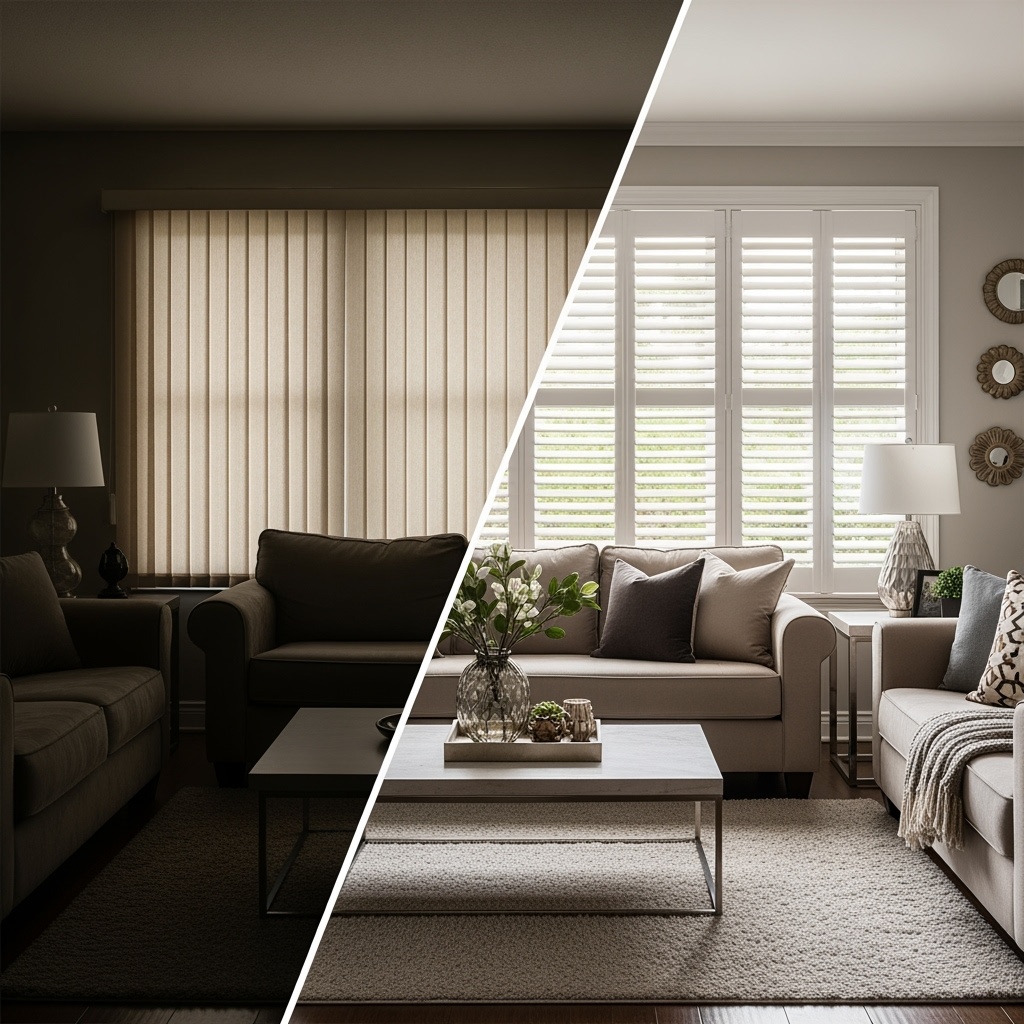
    One of the best type of blinds for living room is vertical blinds, also known as panel track blinds, which feature vertical panels of hard textiles that run along a track system. They are available in many different light-filtering materials, from simple neutral tones to complex patterns.

    Ideal for:

    Very wide windows, like wall-to-wall windows, or for sliding glass doors.

    3) Zebra blinds

    Zebra blinds or double roller shades comprise two layers of material with alternating sheer and opaque bands. These blinds can also be fully lifted and lowered, giving you lots of flexibility for light and privacy.

    Ideal for:

    Easy light and privacy control for large and small windows.

    4) Venetian blinds

    Venetian blinds are one of the modern blinds for living room, featuring tiltable vanes between two sheer layers of material. You can also lift the entire shade up for a completely unobstructed view. These are available in multiple neutral tones with vanes that are either light-filtering or blackout, so you get a versatile, attractive aesthetic with the right level of privacy and light filtration.

    Ideal for:

    Soft and linen look for the living room with easy light and privacy control.

    5) Roller blinds

    One of the popular styles of window treatment with a single panel of hard textile that rolls around the tube at the top of your window. They are available in different colors, textures, and patterns that fit in both light-filtering and blackout options.

    Ideal for:

    Softening light and darkening the room.

    6) Solar blinds

    The best type of blinds for living room is roller blinds with a single panel of UV-blocking material that rolls around a tube. They offer a unique ability to block light up to 99%, while still allowing natural light to filter into your home.

    Ideal for:

    Easy light and privacy control for large to small windows.

    7) Roman blinds

    These blinds feature soft fabric that folds into itself when raised and unfolds in a cascading motion when lowered. They come in six styles ranging in terms of aesthetics and functionality.

    Ideal for:

    An elegant or casual look with excellent insulation.

    8) Woven blinds

    Bamboo blinds or woven blinds are made from natural woven fibers like reeds, bamboo, and grasses that add texture and warmth to your living room with their organic aesthetic. These blinds for living room are found in four different styles, and each of them is functional and easy to use.

    Ideal for:

    Filtering out light and darkening the room. A good source of insulation with privacy and blackout lining.

    9) Cellular blinds

    These modern blinds for living room feature a unique honeycomb design with pleated fabric cells that expand and contract like an accordion when the shade is raised and lowered. They come in single-cell and double-cell options in a variety of versatile neutral colors.

    Ideal for:

    Creating a simple and minimalist aesthetic, controlling light and privacy as needed.

    Conclusion

    The choice of the best type of blinds for living room comes down to comfort, style, and the way you want your space. The right choice will brighten the room, improve privacy, and make the space feel more complete.

    FAQs

    What type of blinds are best for a cozy living room?

    Roman blinds and woven blinds are great choices. They add warmth and make the room feel inviting.

    Which blinds are easiest to clean?

    Roller blinds and Venetian blinds are usually easy to wipe and maintain.

    Are blinds better than curtains for living rooms?

    Blinds give a cleaner look and better control over light and privacy. Curtains can feel softer, but blinds are often more practical.

    Can I use blinds on large living room windows?

    Yes, vertical blinds, motorized blinds, and solar blinds work well for large windows.

    How do I choose the right blind color?

    Pick a color that matches your walls, furniture, and overall style. Light shades make the room feel open, while darker shades create a bold look.

  • What are Venetian Blinds

    What are Venetian Blinds

    Venetian blinds are simple, stylish, and practical, which makes them a classic choice for windows year after year.

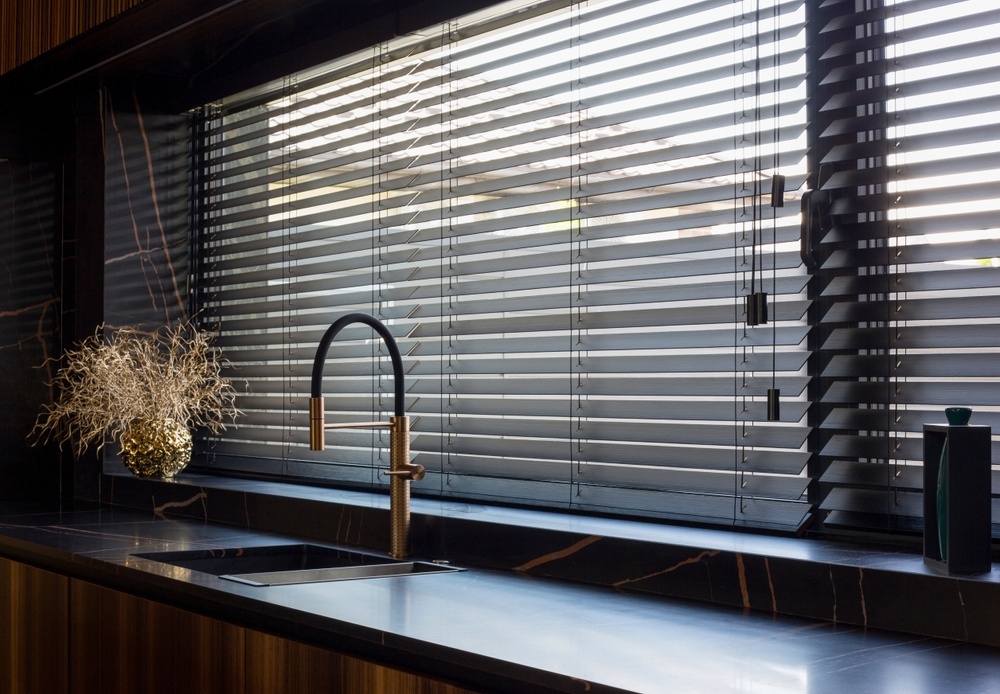
    Out of many types of blinds, venetian blinds are a popular and versatile window treatment known for their timeless appeal and practicality in interior design. These blinds are distinguished by horizontal slats, made of wood, metal, or PVC. These are tilted to control the amount of light and privacy in a room.

    But the question remains unanswered, what are venetian blinds, their history, and everything we need to know about them?

    What are Venetian blinds?

    Unlike roller blinds, which are made from compact material that rolls up and down to control the amount of light that enters the room. These are horizontal blinds engineered with adjustable slats for greater precision over privacy, airflow, and light control.

    History of Venetian blinds

    The history of the Venetian blind truly begins in Persia (modern-day Iran), Japan, and China, where early versions consisted of woven bamboo curtains that could be adjusted up and down to control light and air. However, it was in Venice that it evolved into the version we know today.

    These blinds are no longer old, dusty blinds with clunky cords. They have evolved from basic wood and cord systems to durable, high-tech solutions. Modern versions use materials like aluminum and faux wood, with an option to motorize them for smart homes.

    4 Types of Venetian Blinds

    Some types of Venetian blinds include wooden, faux, aluminum, and PVC.

    1) Wooden venetian blinds

    These blinds are made from real wood, like basswood or cedar. They are known for their natural, warm appearance and are a great fit for classic and traditional interiors. These window treatments are timeless and can be stained or painted to match the decoration style. They help in adding value to your home.

    2) Faux wood venetian Blinds

    These blinds are crafted from composite materials or PVC. Being durable blinds, they can mimic the look of real wood but also offer increased scratch and moisture resistance. This makes them suitable for high-humidity areas like bathrooms and kitchens. Additionally, they have color-fastness properties, so they do not turn yellow or fade over time.

    3) Aluminum venetian blinds

    These blinds feature slats that are made of lightweight aluminum. They have a modern, sleek appearance and are extra sturdy. You will find them installed in contemporary or industrial-style interiors. Apart from being fashion-forward, they are also heat and moisture resistant, making them an interior designer’s go-to pick for kitchens and bathrooms.

    4) PVC venetian blinds

    PVC venetian blinds are made from polyvinyl chloride, a type of plastic. They are known for being affordable and easy to clean, but lack the style and staying power of other materials.

    How do They Work?

    Venetian blinds are one of the family’s favorite choices because they are easy to operate using a simple yet effective mechanism. Their key components include:

    • Slats: These are horizontal and individual strips that make up the body of the blinds. You will often find them made of various materials like wood, metal, or PVC.
    • Headrail: The horizontal bar at the top of the blinds where the slats are attached. It holds and supports the entire blind structure.
    • Tilt mechanism: A tilt wand or cord is used to adjust the angle of the slats. Turning the wand or pulling the cord tilts the slats, controlling the amount of light and privacy.
    • Lift cord: The lift cord raises and lowers the blinds. When you pull the cord, the blinds are lifted, and when released, they lower.

    Why Choose Venetian Blinds

    This image is generated using ChatGPT.

    There should be something that compels you to choose these blinds. It is their versatility in style, budget-friendliness, easy maintenance, and customization options that make them the ideal choice.

    • Versatile in style

    Venetian blinds have been one of the iconic window treatments for centuries due to their versatility. You will find them in an array of luxury materials, colors, and slat sizes. This makes them adaptable to a wide range of interior design styles, from traditional to modern.

    • Privacy control

    You can enjoy your dinner on the dining table away from prying eyes, or set the ambiance in the living room and unwind in peace. The adjustable slats allow precise control over light and privacy, making them an excelelnt choice for spaces.

    • Easy to maintain

    These blinds are easy to clean and maintain with regular dusting or light cleaning. This step helps keep the space looking fresh and well-kept. The process is simple. You just need a clean microfiber cloth for dusting and a mild soap and warm water to clean off grime or stains.

    • Budget friendly

    Venetian blinds can be a cost-effective window covering solution, especially with faux wood options available to fit various budgets. When you choose standard-sized blinds vs. custom-made-to-order shapes and sizes, this can be a great way to save money.

    • Customized according to your space

    These window treatments have the ability to be tailored to fit your window perfectly and ensure a seamless and polished look. So if you have got large windows, tall windows, or a special shape that is a challenge, venetian blinds can solve all issues.

    • Motorized options

    Modern blinds can be equipped with motorized systems for convenience. This allows you to control them with the touch of a button or through a smart system. Get an option to raise, lower, or adjust your blinds anywhere in your home to completely control light levels, privacy, and desired ambiance.

    Conclusion

    What are venetian blinds? These blinds are a practical and stylish choice for almost any home. They give you control over light, privacy, and the overall look of a room. With so many materials and styles available, it is easy to find one that suits your space. Whether you want something classic or modern, venetian blinds are a reliable option.

    FAQs

    Are venetian blinds suitable for all window sizes?

    These blinds can be customized to fit various window sizes. This makes them suitable for many different window dimensions.

    Can venetian blinds be cut to fit my window?

    Yes, they are often cut to fit your window, but it is essential to have this done by a professional to get the proper fit and maximum functionality.

    Are these blinds suitable for high-humidity areas?

    They are made of materials that are designed to withstand moisture and are less prone to warping and paint cracking.

    How can we replace a broken slat on venetian blinds?

    Most of the blinds have a removable plug at the bottom rail. Take the blind down and slide the plug out. You will see a knot that holds the slat, and untying it will release the damaged slat. Replace it with a new one.

    Do venetian blinds block out all sunlight?

    Venetian blinds can reduce light, but they do not usually block it out completely. Small gaps between the slats may still let some light in.

  • How to Measure Curtains for a Dubai Apartment (Step-by-Step)

    How to Measure Curtains for a Dubai Apartment (Step-by-Step)

    Achieving a high-end designer look for your home does not begin with picking the right fabric. You need to learn how to measure curtains. For this, jotting down the right window size is important. 

    Whether you are looking for the finest curtains in Dubai has to offer, or upgrading your room environment with blackout curtains. The right dimensions are the difference between a polished finish and a DIY disaster.  

    If your Dubai curtains are not measured properly, this will lead to wrong installation, giving a dull look to your space. Therefore, it is essential that a person learns the right technique to measure the window for perfect treatment. 

    Steps to Measuring the Windows for Curtains 

    If you are measuring windows, doors, or skylights for your new curtains, this might sound difficult and exhausting. But you just need the right information to begin. Following certain steps will serve as a green signal, and you are good to go. 

    Step 1: Assemble all your Tools 

    The first step to measure curtains for a successful window project is gathering the correct tools. It is recommended to use a steel measuring tape as the fabric tape can stretch over time and lead to significant inaccuracies. 

    You will also need a sturdy step ladder to reach the top of the window frame. Keep a notebook with you to jot down the measurements immediately. Remember, you should never rely on your memory for the dimensions, as a quarter-inch mistake can ruin the final look of your installation. 

    Step 2: Determine Rod Placement 

    After you have all the tools with you, the next step for Dubai curtains is to measure the window side to side. This includes the trim even. Then you must add up to 16 to 24 inches to your measurements. Later, choose a rod that will extend your determined width. This makes the window look bigger and the room brighter by letting in enough light. 

    Now, you have to measure the height of your window. If your ceiling is a standard 8-foot ceiling, then take the curtain rod to the ceiling. If there are crown moldings on your ceiling, mount the rod just below them. Similarly, if your ceilings are higher, then choose a spot 12 to 14 inches above the top of the window. 

    Step 3: Measure the Curtain Width 

    You can measure curtains and determine their width by first installing the curtain rod or track and then measuring their length from end to end. You can also add in the extra space where you will extend the rod past the window. This will add to the overall width of the curtains. 

    Step 4: Determine the Curtain Length 

    To measure the length of the curtain, determine your curtain’s position. For those curtains that fall to the floor, ensure that you measure from the top of the curtain rod to the floor. Add 1-3 inches to your measurements if you want your curtains to have a slight break on the floor or if you want them to pool gracefully. 

    Step 5: Double-Check Everything 

    Before you place the order for your curtains in Dubai, check the dimensions. Reach the curtain maker like Aura Curtains with your measurements and check what will work for your window treatment. If you find yourself caught between two sizes that match your measurements, then better to choose the bigger one. 

    Excess fabric can be trimmed off professionally, but a curtain that is too short or too narrow will always look out of place. Following this little trick will prevent you from diminishing the aesthetic value of your home. 

    Step 6: Installing the Curtains 

    After all the preparation steps to measure curtains, here comes the fitting part. For some individuals, hanging the curtains is the most thrilling task to do. The job is easy and fun if the right steps are followed. 

    • The tools that you will need at this time for installation are curtains, curtain rods, mounting brackets, a drill, a pencil, and a measuring tape. Additionally, you need to keep a leveling tool, some extra screws, and a screwdriver before you climb for installation. 
    •  The measurements taken earlier will help with the installation. Once you have accurately measured the height and the width of the rod. Write down the measurements properly. 
    • Now take a pencil and mark the holes where you want to drill and attach the brackets. Each one must be at the previously determined height and about four to six inches from the side of the window frame. Taking this step will help you open the curtain fully and smoothly. 
    • Before you hang the curtains up on the rod, ensure that they are properly ironed. Then, uncap the finials from the rods so that you can easily thread the curtains through. Also, ensure that you tighten the screws to secure the rods. 

    Simple Styling Tips for an Elevated Look 

    Once your measure curtains part is completed, the next step is to style them in a smart way. This is where small design choices can make a big difference. A few simple touches can change the whole feel of the room and make your curtains look more elegant and complete. 

    • Add extra inches to the obtained measurements for a fuller look when you are styling it. 
    • Mix and match different fabrics and colors. 
    • You can also add sheer curtains as the base, in case you want enough of the natural light to enter, and then top it with a heavier fabric. This will give an elegant look. 
    • You can go for a metallic finish for curtain rods, brackets, rings, and tiebacks. This will make your curtains last longer. 

    Conclusion 

    Following the accurate way to measure curtains will set the basis for a good window treatment. Now that is your choice, you want them flowing or if you prefer heavier options. All the measurements you have jotted down will make it look professional and increase its functionality. For all this, you just need a few tools and attention to detail. Design your space with confidence and enjoy the comfort that meets the elevating winds of decor. 

    FAQs 

    What curtain length looks best in a Dubai apartment?

    Floor-length curtains usually look the most elegant. They also make the room feel taller and more polished.

    Should curtain rods be wider than the window?

    Yes, slightly wider rods help the curtains cover the full window properly and let in more light when open.

    Can I measure curtains by myself?

    Yes, you can. Just use a steel measuring tape and write down each measurement carefully to avoid mistakes.

    What if my window measurements are not exact?

    It is better to round up slightly. A larger curtain is easier to adjust than one that is too short.

     Do blackout curtains need different measurements?

    The measuring method is mostly the same, but blackout curtains often need better side coverage to block more light.

  • Curtains vs Blinds – Which Is Right for a Dubai Villa?

    Curtains vs Blinds – Which Is Right for a Dubai Villa?

    Curtains and blinds are two of the most popular window covering solutions that stand on their own strengths. Especially in Dubai, where you can’t compromise on avoiding this feature due to the blazing Sun throughout the year.

    The skyline of Dubai is full of stunning infrastructure, especially the Villas, with open layouts and floor-to-ceiling windows, which give a sense of spaciousness. Here, the selection between curtains and blinds becomes complex for property owners.

    Here is a detailed guide that will help you clearly understand which one to choose between blinds and curtains for Dubai villas that transform windows into statements.

    A Quick Breakdown of Curtains vs Blinds

    Let’s have a look at the key comparison of blinds and curtains in Dubai that how these window treatments are differ in adding appeal, privacy, blocking sunlight, along ease of installation and maintenance.

    Features Curtains In Dubai Blinds In Dubai
    Materials Lightweight fabrics like sheer, velvet, blackout Hard materials like wood, PVC, or aluminum
    Heat Protection Strong heat protection if the fabric is thick Adjustable heat and light control
    Privacy Complete coverage of space Privacy level can be adjusted
    Light Control Varies from sheer (soft light) to blackout (full darkness)  Precise control of lighting by moving slats
    Durability Depend on the fabric quality Stays for a long time if maintained
    Cost Efficiency Mid to high cost depending on fabric and customization  Expensive due to the material used
    Maintenance Easy to clean by washing or dry cleaning Need surface dusting or cleaning with a damp cloth
    Installation Usually not require professionals Need a professional for seamless installation

    Curtain Essentials for a Perfect Interior Setup 

    Curtains are more than just draping pieces of fabric in Dubai villas; they are an essential part of the interior that enhances the overall ambiance when chosen carefully. Used for centuries as a traditional window treatment, curtains have evolved in both style and functionality.

    Most Loved Curtain Designs For Dubai Villas 

    From blackout to motorized, let’s uncover the most in-demand curtains in Dubai that shows how each option elevate your living space in a different way.

    • Blackout to Thermal Curtains: Made up of thick fabric and can control 99-100% of light with maximum privacy.
    • Sheer Curtains: Made up of soft fabric, which helps in diffusing sunlight and creates a soft ambient appeal.
    • Layered Curtains: A combination of dual fabrics like blackout and sheer to maximize functionality in both day and night.
    • Floor-to-Ceiling Curtains: Ideal for Dubai villas, covering large windows and lending a royal vibe to the space.
    • Motorized Curtains: Give a vibe of a smart home to your luxurious villa by offering convenient light and privacy control through remote systems.

    Cost of Curtains in Dubai

    From ready-made to customized curtains, the price may vary, approximately ranging from AED 100 to AED 600.

    Redefine Your Villa’s Interior With Blinds

    If you want to give your Dubai villa a modern and sophisticated touch, then blinds are one of the most effective window covering options. These modern window treatments are designed with adjustable slats made from materials like wood, PVC, or aluminum that give a sleek appearance. 

    New Wave of Trendy Blinds In Dubai

    Among list of blinds blackout, motorized, zebra, roman and venetian are known for their unqiue features which actually your villa needs. Here are features of each one:

    • Blackout Roller Blinds: Sleek and modern type of blinds that give ultimate protection against Dubai’s intense climate.
    • Motorized Blinds: Smart, automated, and convenient option, ideal for large windows and hard-to-reach areas. 
    • Zebra Blinds: A combination of sheer and opaque panels for stylish light and privacy control throughout the day.
    • Roman Blinds: Gives an elegant vibe of fabric in the structure of blinds, made from fabric, and fold neatly when raised.
    • Venetian Blinds: Classic and versatile option with adjustable horizontal slats for precise light control.

    Cost of Blinds In Dubai

    The cost of blinds varies depending on type, from basic to premium, ranging from AED 300 to AED 3000 in Dubai.

    Discover The Benefits of Blinds & Curtains In Dubai

    Curtains and blinds in Dubai come with different advantages, where curtains are budget-friendly and easy, blinds provide modern automation and enhanced control. Let’s have a look at the beneficial differnece of both window treatment solutions:

    Advantages of Curtains

    Choosing the right curtains can bring a bundle of benefits to your space. Some significant points are mentioned below:

    • Add luxury, warmth, and elegance to interiors.
    • Provide complete coverage that maximizes privacy.
    • Offer insulation against Dubai’s heat and sunlight.
    • Easy to install and maintain with a simple cleaning process.
    • Cost-effective solution, available in a variety of colors, designs, and fabrics.

    Advantages of Blinds

    Installing blinds in villa windows is a stylish and practical way to enhance the overall interior appearance, but beyond modern appeal, blinds offer practical advantages:

    • Precise control of lighting by tilting slats.
    • Aluminum and vinyl blinds are resistant to wear and tear.
    • Ideal for contemporary Dubai villa interiors, due to modern appeal.
    • Available with motorized and smart features, which are safer for kids and pets.
    • Maximized privacy by adjusting slats to block outside view.

    Don’t Skip The Drawbacks of Blinds & Curtains

    A smart and strategic decision always requires understanding the hidden drawbacks along with the benefits. So here are some potential weaknesses of blinds and curtains that guide you to invest wisely:

    Curtains Blinds
    Required frequent cleaning and washing, which may feel overwhelming Dust accumulation, especially in slatted designs, which require frequent cleaning 
    Strong sunlight can gradually fade and reduce the color vibrancy Blinds with aluminium and PVC material can crack or wear over time due to heat exposure
    Feel bulky in compact spaces, making small rooms appear heavier  Allow small light gaps, which may reduce complete darkness in bedrooms 
    High-quality or custom-designed curtains are expensive, especially for large windows Less budget-friendly option due to its installation and maintenance

    What to Consider Before Choosing Blinds or Curtains?

    Whether you want to buy curtains for a home renovation or blinds for a minimalist look, both require careful considerations about need and preferences before investing. Here are some key factors you must evaluate before making your final decision: 

    • Amount of Comfort You Need

    Clearly define the level of comfort you want in each room, whether it is complete blackout for restful sleep, soft filtered light for a relaxed ambiance, or adjustable control for flexible daily use.

    • Focus on Your Budget

    Set a realistic budget before selecting window coverings like blinds and curtains in Dubai, and as prices can vary according to many aspects, ensure your choice fits your budget and needs.

    • Energy Efficiency & Ease of Maintenance

    Choose window coverings that support energy efficiency by reducing heat, blocking harsh sunlight, and improving indoor insulation, especially in Dubai’s climate. 

    • Room Dimension & Window Size

    Evaluate your room size and window dimensions carefully, as they directly influence the visual balance and functionality of curtains or blinds. 

    • Align With Your Existing Decor

    Ensure your window coverings complement your existing interior design, including color palette, furniture style, and textures, as they seamlessly blend with your choice of decor theme.

    Where to Buy Curtains And Blinds In Dubai?

    If you are looking for premium-quality curtains or blinds for your Dubai villa, Aura Curtains is one of the trusted providers that is highly committed to quality and customer satisfaction. From offering a diverse range of curtains and blinds in Dubai to offering comprehensive installation services, we are proudly serving our expertise across the UAE. Whether it is a home, apartment, or villa, our window treatments are customizable to fit perfectly in every window.

    Bottom Line

    According to professional interior designers, curtains are often the preferred choice for villa windows due to their elegance, scale, and versatility. In villas, windows are usually larger and more architectural, where curtains work to enhance that sense of height and openness.

    Floor-to-ceiling drapes create a luxurious, flowing look that complements spacious interiors. Feeling excited to explore our lavish collection of curtains? Then contact Aura Curtains to choose the one that makes your windows a statement that grabs instant attention.

    FAQs

    Are blinds more costly than curtains?

    Yes, blinds are considered more expensive due to the material used in designing, while curtains are cost-effective as it is based on fabric quality.

    Are roller blinds better than curtains?

    Yes, roller blinds are known for their sleek, modern appearance, but like curtains, they can not provide enough warmth, elegance, and better insulation for larger villa-style spaces.

    What are the risks related to blinds?

    The main risk related to blinds is that they have cords posing safety risks for children, and if the material is cheaper, it can easily break or crack.

    Is a curtain or a blind better for the kitchen?

    As compared to curtains, blinds work better in kitchens because they resist moisture, are easier to clean, and don’t absorb cooking smells.

    How to choose the right curtains for a villa?

    Your decision to choose curtains based on room size, fabric quality, color harmony, and layering to enhance the villa’s elegance, comfort, and natural lighting balance.

  • Best Curtain Fabrics for Dubai’s Climate

    Best Curtain Fabrics for Dubai’s Climate

    Blackout curtains are the best choice, as they block sunlight, add privacy, and reduce noise. This is essential to Dubai’s climate. 

    You need to look for fabrics that help you design blackout curtains that look elegant and meet your needs. Your choice will affect how well the curtains work, from blocking out light to softening sound. With a variety of options available on the market, choosing the right material is one of the biggest tasks. 

    Upgrade your space with Curtains in Dubai that help you to design the best for your windows. 

    Top 15 Curtain Fabric Choices for Dubai’s Weather Conditions 

    Dubai is a desert area where residents face extreme weather for most of the year. The sun shines for most of the year, with the hottest days and nights. In such weather conditions, individuals look for the best curtain fabrics that provide privacy. Additionally, they want something that can prevent extreme UV rays from entering and keep the space cool.

    • Linen Curtains 

    One of the natural fabrics that is made from flax fibers. This gives them a breathable and relaxed texture.  

    Why choose Linen: 

    • Allows airflow. 
    • Regulates temperature. 
    • Creates a natural and elegant look. 

    Places you can install them: 

    Living rooms, dining areas, coastal, and modern interiors. 

    • Velvet Curtains 

    Looking for luxurious Dubai Curtains that match Dubai’s climate, then velvet is the right choice. It is a thick, soft fabric that feels luxurious and helps keep the rooms insulated. 

    Why choose velvet: 

    • Excellent blackout performance. 
    • Reduces external noise. 
    • Adds richness and warmth. 

    Places you can install them: 

    Bedrooms, home theatres, and luxury interiors. 

    Cotton is a natural fabric that is versatile, breathable, and neither too heavy nor too light. 

    Why choose cotton: 

    • Easy to clean. 
    • Soften lights 
    • Works well with linings. 

    Places you can install them: 

    Living rooms, bedrooms, and family spaces. 

    Looking for options of curtains in Dubai, Silk is a high-quality natural fabric that has a smooth and shiny surface. 

    Why choose silk: 

    • Enhances room brightness. 
    • Strong yet lightweight. 
    • Adds a refined finish. 

    Places you can install them: 

    Formal living rooms and luxury bedrooms. 

    • Nylon Curtains 

    One of the man-made fabrics that stretches easily and lasts for a longer time. 

    Why choose nylon: 

    • Moisture-resistant. 
    • Wrinkle-free. 
    • Holds colors well. 

    Places you can install them: 

    Dining rooms, sunrooms, and a modern interior. 

    • Voile Curtains 

    With the extreme weather conditions, you still want to enjoy the early morning sunrays to enter your space. Voile is the best curtain fabric Dubai, as it is a light and see-through fabric. 

    Why choose voile: 

    • Filters sunlight. 
    • Enhances privacy during the daytime. 
    • Easy to maintain. 

    Places you can install them: 

    Living rooms and layered window treatments. 

    Another Dubai Curtains option available is man-made fabric that comes in different thicknesses. 

    Why choose polyester: 

    • Wrinkle-resistant. 
    • Budget-friendly.
    • Effective for blackout when lined. 

    Places you can install them: 

    Bedrooms, offices, and apartments. 

    • Brocade Curtains 

    A new type of the best curtain fabrics, with raised patterns woven into the fabric that feel firm when touched. 

    Why choose Brocade:

    • Naturally opaque. 
    • Improves insulation. 
    • Decorative appeal. 

    Places you can install them: 

    Formal living rooms and statement windows. 

    • Wool Curtains 

    Yes, you read it right. Dubai homes are found with wool curtains as they keep the room warm and help reduce noise. 

    Why choose wool: 

    • Regulates indoor temperature. 
    • Reduces noise. 
    • Durable and breathable. 

    Places you can install them: 

    Bedrooms, living rooms, and for keeping the room cooler for longer. 

    • Jacquard Curtains 

    The best curtain fabric Dubai, jacquard, is known for its woven patterns and for keeping its shape over time. This means you don’t need to worry about changing them after some time. 

    Why choose jacquard 

    • Excellent light control. 
    • Long-lasting texture. 
    • Adds visual depth. 

    Places you can install them: 

    Offices, hotels, and premium interiors. 

    • Satin Curtains

    Looking for something that is smooth and has a shiny appearance? Then satin will work as it is designed for Dubai homes. 

    Why choose satin:  

    • Reflect light softly. 
    • Easy to maintain. 
    • Works well with blackout lining. 

    Places you can install them: 

    Living areas and formal spaces. 

    • Chenille Curtains 

    Chenille curtains are designed to give a soft and velvety feel that helps keep the room warm. 

    Why choose Chenille: 

    • Effective in absorbing sound. 
    • Clocks light effectively. 
    • Comfortable and durable. 

    Places you can install them: 

    Kids’ rooms and family rooms. 

    • Suede Curtains 

    The best curtain fabric Dubai, Suede, has unique features that make it an ideal choice. It has a soft and non-shiny surface that is neither too thick nor too thin. 

    Why choose suede: 

    • Reduces glare. 
    • Adds warmth. 
    • Resistant to scuffs. 

    Places you can install them: 

    Bedrooms, offices, and lounges. 

    • Rayon Curtains 

    Rayon is a partly man-made fabric that is made from plant fibers. 

    Why choose rayon: 

    • Lightweight and fluid. 
    • Good color clarity. 
    • Suitable for lining. 

    Places you can install them:  

    Living rooms and decorative spaces. 

    • Taffeta Curtains 

    The last but not the final choice you have for curtain fabric in Dubai is choosing taffeta. This is a stiff fabric that holds its shape well. 

    Why choose taffeta: 

    • Strong light blocking. 
    • Maintains sharp folds. 
    • UV-resistant. 

    Places you can install them: 

    The living room, dining room, and bedrooms are the best places to upgrade the look.

    Conclusion 

    There are a variety of curtains in Dubai. The fabric you choose will affect comfort, privacy, and how your space looks. Velvet, wool, polyester, and acrylic are good for blocking light and keeping rooms warm. Damask and suede help reduce noise. Chiffon, voile, and rayon let in more light and make rooms feel brighter. Thick ones help with insulation and noise, while sheer ones make spaces feel open and airy. 

    FAQs 

    Which curtain fabric is best for Dubai’s hot weather?

    Linen, cotton, and voile are good choices. They let the air pass and feel light in the room.

    Which curtain fabric blocks the most light?

    Blackout fabrics work best. Velvet, polyester with lining, and taffeta are strong options.

    Which curtain fabric helps reduce noise?

    Thick fabrics like velvet, wool, and chenille help absorb sound better.

    Are sheer curtains good for Dubai homes?

    Yes, they are. Sheer curtains bring in natural light and still give some daytime privacy.

    Which curtain fabric is best for a luxury look?

    Silk, velvet, brocade, and jacquard give a rich and elegant finish.